Who likes caves? If you’re fascinated by hidden worlds beneath the earth’s surface, Jewel Cave National Monument is a place you won’t want to miss. While our complete guide to Jewel Cave National Monument covers everything you need to plan your visit, this article focuses on what it’s actually like to take a ranger-led cave tour and experience one of the world’s longest cave systems firsthand.
This post may contain affiliate links, meaning if you purchase something through one of these links, we may earn a small commission at no extra cost to you! Read the full disclosure policy here.

Established on February 7, 1908, Jewel Cave was the first cave designated as a national monument. Standing at the surface, you’d never guess that hundreds of miles of passages lie beneath your feet. Descending underground on the Scenic Tour reveals glittering calcite crystals, impressive formations, and an underground world unlike anything we’ve experienced.
Located in the Black Hills of South Dakota, Jewel Cave formed over millions of years as slightly acidic groundwater slowly dissolved the surrounding limestone, creating the remarkable cave system visitors explore today.
If you’re planning a longer Black Hills vacation, Jewel Cave is also one of the highlights of our South Dakota and North Dakota road trip itinerary.

Table of Contents
Booking a Guided Tour Through Jewel Cave
Planning to explore Jewel Cave? Make reserving a tour one of the first things on your to-do list. The cave can only be visited on a ranger-led tour, and the most popular options often fill well before the busy travel season.
Reservations can be made online through Recreation.gov before your visit. Depending on availability, the visitor center may also have a limited number of same-day tickets, but we wouldn’t count on them if you’re visiting during the summer months.
Jewel Cave offers several guided tours throughout the year, ranging from easy walks to more adventurous experiences. Since tour schedules and seasonal offerings can change, it’s always a good idea to check the official park website before your trip for the latest information on tour options, availability, and pricing.
For our visit, we chose the Scenic Tour, the park’s most popular ranger-led experience. It offered the perfect introduction to the cave, with incredible formations, fascinating stories from our ranger, and plenty of opportunities to appreciate the immense underground world hidden beneath the Black Hills.

Year-Round Adventures: Discover Jewel Cave’s Guided Tours
Discovery Tour-This 20-minute tour is short and sweet. They offer the ‘Discovery Talk’ year-round. Visitors view one large room of the cave. The Discovery Tour is the only tour that allows service dogs trained to perform a task for people with disabilities.
Scenic Tour-This tour is moderately strenuous, lasting one hour and twenty-minutes. It provides a great overview of the cave and its formations, including calcite crystals, draperies, stalactites, and stalagmites. You must be able to climb 743 stairs over 0.5 miles descending to 280 feet below the surface. Safety Requirements: Parents may not carry a child of any age. Infants and toddlers can be carried in a front-carrier only, and the child must remain in the carrier throughout the duration of the Scenic Tour.

Summer-Only Access: Jewel Cave’s Seasonal Tours in the Black Hills
Historic Lantern Tour-During summer only, Historic Lantern Tours take place one mile west of the visitor center in the Historic Area of the park. This one-hour and 45-minute tour will take you back in time with only a lantern to guide you. You must be able to climb 500 narrow wooden stairs. Tours are at 9:45 a.m., 12:45 p.m. and 3:30 p.m. (maximum of 20 participants).

Wild Caving Tour-This caving adventure is a strenuous four hours, taking only 5 people at a time. You must be 16 and older to take part. Just outside the theater room is a box that you must be able to squeeze through an 8.5” x 24” to take part in this tour. This tour also begins at the historic entrance.

Essential Tips for Your Visit
- Popular tours sell out fast, especially in summer! Book your Scenic Tour or Historic Lantern Tour in advance via Recreation.gov. Check current tour availability and park alerts before your trip!
- Arrive Early & Check In: Plan to arrive 30 minutes before your tour for safety briefings.
- NOT allowed inside the cave are backpacks, bags and purses, water bottle, food stuffs and selfie sticks. They only allow front baby backpack carriers.
- It’s a constant 49 degrees inside the cave. You will need a jacket or a sweater.
- NO flip-flops or sandals. Closed-toe shoes or hiking boots are required.
- Flash photography cameras are allowed.
- Please do not touch cave formations; the oil from your hands can damage them permanently.
- Be Alert! Watch your head, duck for low-hanging ceilings.
- White-nose syndrome, a fungal disease deadly to bats, has been detected at Jewel Cave. All cave tour participants must walk across a decontamination mat when exiting the cave.
- Combine your visit: Pair Jewel Cave with nearby Wind Cave National Park or Black Hills attractions like Mount Rushmore.

Begin at the Visitor Center—Your Gateway to the Black Hills’ Hidden Wonder
Jewel Cave does not charge an entrance fee. There is currently no food service available at the park. The Visitor’s Center, Park bookstore, trails, and picnic areas are open every day from 8:00 a.m. to 5:30 p.m. There is no food service available at the park. We recommend you bring a refillable bottle of water or plenty of water. Snacks are available for purchase, and refill stations are on site. There’s nothing better than a picnic lunch.
After you check in for your cave tour, there is usually time before or directly after for a self-guided tour of the exhibits. Don’t miss the award-winning introductory park film, “Discovery in the Darkness: Jewel Cave National Monument“ in the theater.

During our tour of the exhibits, we learned the cave is an important hibernaculum for several species of bats. It contains one of the largest colonies of hibernating Townsend’s big-eared bats in the world. Overall, the cave supports nine species of bats.

Uncover A Subterranean Wonder in South Dakota
The Discovery and Scenic Cave tours begin at the visitor center. Look for the signs near the elevators. Ranger Aimee led our scenic tour today. Quickly going over the rules, the group (30) entered the elevator, descending 250′ deep underground into the subterranean labyrinth.

PRO Tip: The Ranger will assigned someone to help make sure no one lagged behind and checked with that person frequently. As the caboose, you get photos with no people in them.
Explore the stunning chambers on a guided scenic tour of Jewel Cave
As soon as you enter the first room, it is like being on another planet. Why is called the Target Room? Well, during construction of the elevator shafts in 1965, surveyors had to be ‘right on target’ while inside the cave to provide exact coordinates.
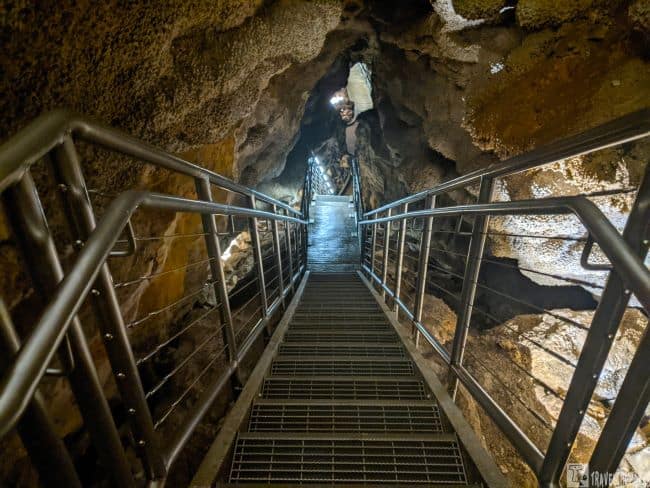
Ranger Aimee explained that Jewel Cave is a dry cave at least 99% of it is. Multiple sets of cold metal stairs ending at large landings with benches where Ranger Aimee shared more information about the different rooms. The entire cave is dimly lit by LED lighting. Unfortunately, dim lighting makes photographing the formation truly difficult.

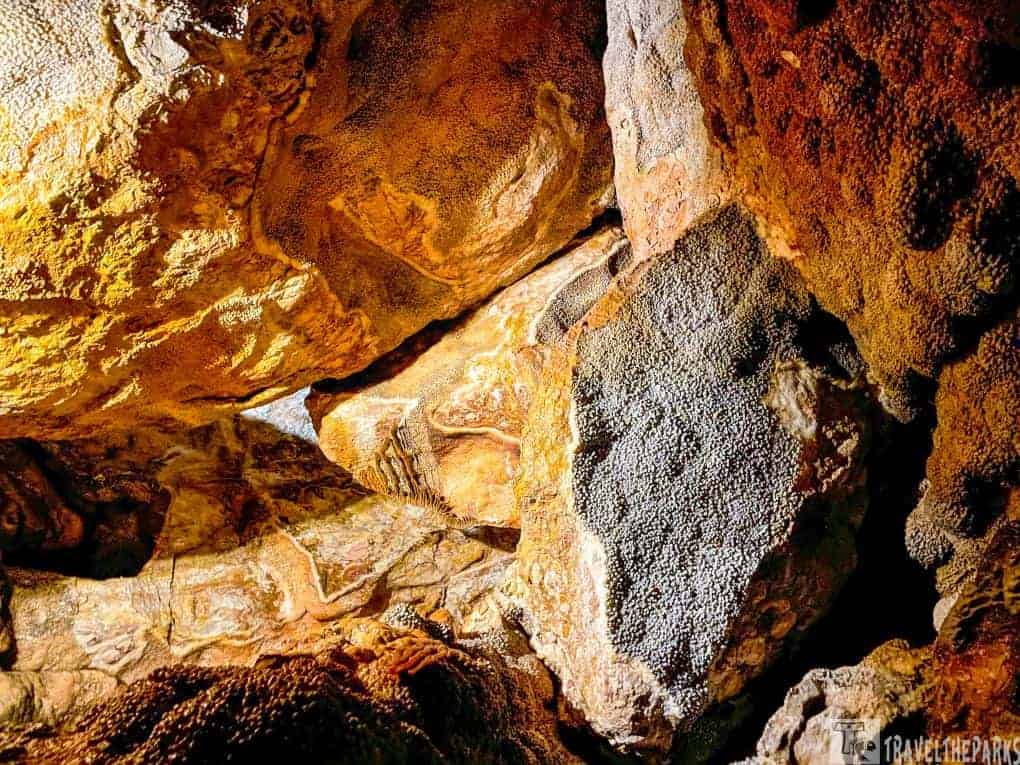
Ranger Aimee pointed out Surprise Loft in the target room. It is a large opening in the ceiling. Lots of cave popcorn dominated this subterranean room. Popcorn is small, knobby growths of calcite, aragonite, or gypsum that can vary in color and appearance. In areas with high airflow, popcorn usually forms in the shape of ball-shaped nodules of calcite that resemble popcorn. The small nodules reminded me of cauliflower. It made it seem like we were inside a crystal cathedral.
We found the two main crystal forms at Jewel Cave are pointy Dogtooth Spar and blunter, Nailhead Spar. Nailhead spar (rhombohedral form) forms after the prominent dogtooth spar therefore, you may see less of it. They both are referred to as the “jewels” of the cave. There is a lot of cave dirt covering the spar, giving it a dull appearance.
Interesting Fact: As soon as the cave was discovered, the glittery crystals were mistaken for quartz and so were associated with gold.

Step Into a Living Landscape: The Dripping Wonders of Jewel Cave’s Formations Room
Rum Runner’s Lane (dry area) leads us to the Formation Room (a wet area). At Jewel Cave, less than 1% of the cave has substantial water movement. The formations room highlights wet formations that include flowstone, draperies, stalagmites, ribbons, columns, and soda straws. Incredible patterns develop depending on evaporation rates.

Our favorite formation was the flowstone. Flowstone is a speleothem that when water flows in sheets over cave walls, deposits calcium carbonate in a drapery-like formation. As these layers accumulate, they shape formations that appear flowing, smooth, glossy, or even create hanging formations called draperies. With its yellowish coloration, this “river of stone” reminded me of icing on a cake. The bigger draperies kind of made me think of large jellyfish or squid.

An additional speleothem found in the cave is aragonite frostwork, typically found as small crusts on the walls. Frostwork is a delicate formation. The needle-like crystals branch out in different directions may be long or short. It may grow on top of other formations, such as cave popcorn.
Another really cool formation is the soda straw. In cave walls and ceilings, soda straws form as water slowly seeps from above to form rings of calcite. This hollow tube gradually lengthens as subsequent drops of mineral-laden water evaporate, elongating the ring. They are quite fragile and relatively rare.

It was in this area when Ranger Aimee had the lights turned off. We found it quite exhilarating to be in total darkness. All you could hear was the distant sound of water dripping. You could not even see your hand in front of your face. Eerie feeling for sure.
Venture into the Shadows: Jewel Caves Eerie Spooky Hollow Chamber
In this chamber, the calcite crystals coated are heavily coated with dark manganese. It overshadows most of the “Spooky Hollow” room. Manganese will stain your skin and clothes. Gypsum decomposes to form manganese, which is a gooey substance.

She told us the term “dripstone” comes from the fact that water droplets form and deposit calcite onto cave surfaces. If you experience a drip, they say it brings you good luck! On our scenic tour, we were lucky enough to get a “cave kiss. ”
Interesting Fact: The Big Duh is Jewel Cave’s largest room, measuring 570 feet long, 90 to 180 feet wide, and 30 feet high. Wall Street, the cave’s tallest passage, reaches 136 feet in height.
The Story Behind the Name: Exploring Jewel Caves Tape Room
There are still some orange pieces of flagging tape in the Tape Room, which is what gave it its name. Sequentially numbered, they tell cavers the direction and how far they are into the cave. Moreover, a historical survey marker “D59” located in this chamber was also used to map the cave.
PRO TIP: How can you tell them apart a stalactite and stalagmite? One way to remember is that the stalactite has a “c” in it, as in “ceiling,” and stalagmite has a “g” in it, as in “ground.”

It Looks Like Bacon, But… What Is Cave Bacon Really?
In reality, cave bacon is a flowstone. This type of formation occurs when water flows down the cave’s walls, forming calcite deposits in sheets. Sometimes, the mineral content in the water causes the formation to appear bacon-colored. The 20-foot section we viewed was very remarkable.

Yikes! Inside the Torture Room at Jewel Cave
The Torture Room is the largest room on the Scenic Tour route, and it is about 185 feet long, 80 feet wide, and averages 50 feet tall (though the tallest point is 110 feet). So, just imagine climbing up and down over rocks with only the light of your headlamp to search for a drip of water. It certainly sounds like torture.
Exiting the cave, returning to the elevators, we all had to step through the decontamination walk for our shoes. White-nose Syndrome, which has been devastating eastern U.S. colonies since appearing in 2006, poses a grave concern for park staff at Jewel Cave. Bats that inhabit this cave have shown the fungus. Rangers want to minimize the spread of the disease outside the cave. If you visit both Wind Cave and Jewel Cave in one day, they recommended a change of clothes to reduce the spread of the disease.

Topside Treasures: What to Enjoy Above Ground at Jewel Cave
Besides underground pursuits, the 1,279 acre park also has above ground surface activities. If you enjoy hiking, check out our Roof Trail. It is only a 0.25 mile hike starting at the visitor center. Grand views from the ridge top of the distant Black Hills and wooded landscape are amazing. If you have time, the 3.5 mile canyon trail passes by the historical entrance where the lantern tour begins. Wildlife can be seen along much of the trail, even though the Jasper fire in 2000 devastated much of the forest woodland. Ranger programs are offered at both the visitor center and the historical area.

Final Thoughts on Our Jewel Cave Scenic Tour
Do you remember the last time you visited a place and instantly fell in love with it? That was our experience at Jewel Cave National Monument. Every cave has its own personality, and this one is unlike Wind Cave National Park, Mammoth Cave National Park, or Carlsbad Caverns National Park. The ranger-led Scenic Tour takes you through a remarkable underground world filled with glittering calcite crystals, massive chambers, and fascinating geology that make every step memorable.
If you’re still deciding which tour to take or planning your visit, be sure to read our complete guide to Jewel Cave National Monument for directions, visitor information, and helpful planning tips. Better yet, include it as a stop on our South Dakota and North Dakota road trip itinerary, where it’s one of the Black Hills’ most unforgettable experiences.
Jewel Cave quickly became one of our favorite cave adventures, and it’s a destination we’d happily visit again. If you enjoy exploring national parks and discovering places that many travelers overlook, this is one stop you won’t want to miss.
What’s the most unexpected place you’ve fallen in love with while traveling? What’s your favorite cave formation that you’ve ever seen? Please share with us in the comments below.