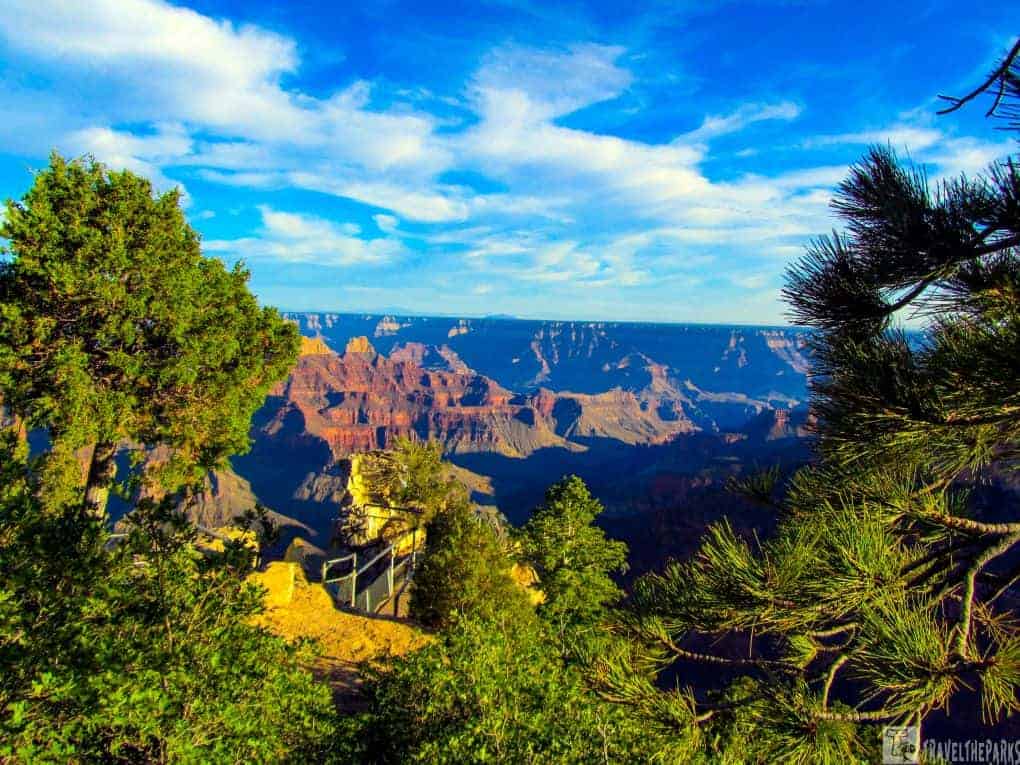
North Rim Grand Canyon Travel Guide wasn’t something we thought we needed when we headed to the North Rim in 2013. We simply wanted to see another side of the Grand Canyon and spend a day exploring. What we found was a quieter, cooler, and less crowded experience than we expected.
Is the North Rim worth the effort? After our visit, I would say a resounding YES! Our North Rim Grand Canyon Travel Guide is based on what we experienced during that trip, along with updates to help today’s travelers understand what has changed.
The North Rim felt completely different from the South Rim. The higher elevation brought cooler temperatures, fewer crowds, and the surrounding Kaibab Forest added another layer to the experience. We could take our time, explore overlooks, hike a few trails, watch for wildlife, and enjoy the historic Grand Canyon Lodge.
We only had one day, but our North Rim Grand Canyon Travel Guide shows just how much you can experience in that time. Some of our favorite moments were the simplest—standing at the rim and taking in a view that is almost impossible to put into words.
Our trip was in 2013, and much has changed since then. The devastating wildfires of 2025 dramatically affected the North Rim, including the loss of the historic Grand Canyon Lodge and other infrastructure.
This North Rim Grand Canyon Travel Guide is therefore a look back at our 2013 experience, with updates where needed to distinguish what we experienced then from what visitors may find today.
This post may contain affiliate links, meaning if you purchase something through one of these links, we may earn a small commission at no extra cost to you! Read the full disclosure policy here.
Table of Contents
Overview of the North Rim of the Grand Canyon
The North Rim of the Grand Canyon offers a completely different perspective than the South Rim. During our 2013 visit, we immediately noticed how much quieter it felt. There were fewer people, cooler temperatures, and plenty of opportunities to simply stop and enjoy the scenery without feeling rushed.
The North Rim sits about 1,000 feet higher than the South Rim, and that elevation makes a noticeable difference. Even in summer, the temperatures were comfortable, especially in the mornings and evenings. We also loved the way the canyon seemed to blend with the surrounding Kaibab National Forest. Instead of endless canyon views, we found ourselves moving between dense forests, open meadows, and dramatic overlooks.
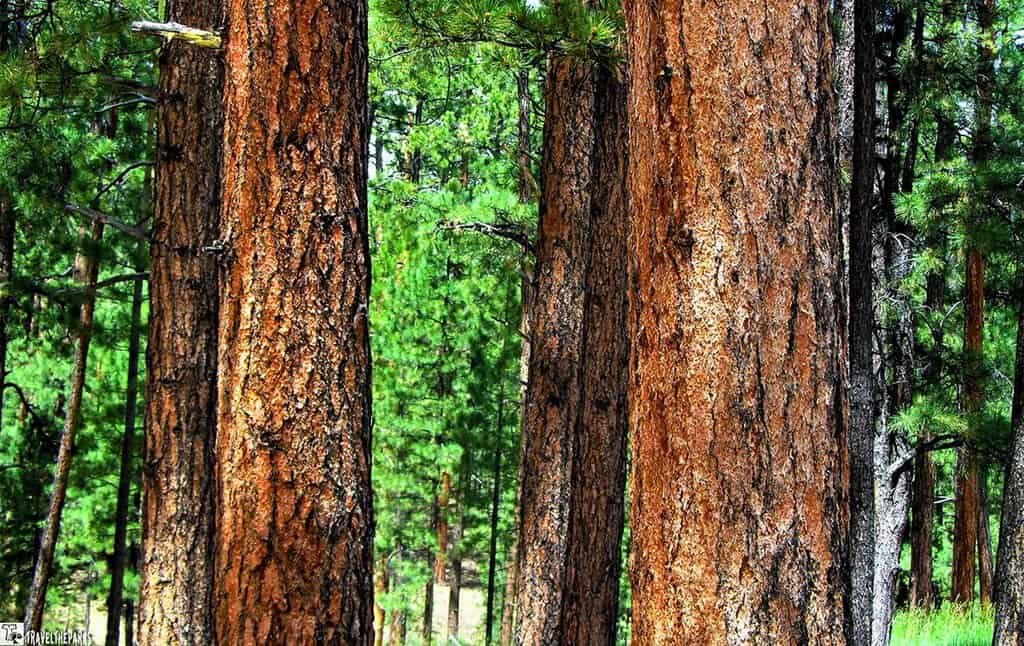
The trails were another highlight. They didn’t feel as crowded as many of the trails we’d experienced elsewhere in the Southwest, and there was something about hiking among the ponderosa pines before suddenly reaching the canyon rim that made each viewpoint feel like a discovery.
Wildlife added to the experience, too. We kept our eyes open along the roads and in the meadows, never knowing what we might see around the next bend.
For us, the North Rim wasn’t about trying to check off as many viewpoints as possible. It was about slowing down, exploring at our own pace, and enjoying a side of the Grand Canyon that felt wonderfully peaceful.
Important North Rim Update for 2026
Our trip to the North Rim was in 2013, long before the devastating wildfires that changed this part of Grand Canyon National Park. If you’re planning a visit today, it’s important to know that the North Rim is open for the 2026 season, but it isn’t the same North Rim we experienced.
According to the National Park Service, the paved roads to Cape Royal and Point Imperial have reopened, along with Highway 67. That means visitors can once again reach many of the iconic viewpoints, including Point Imperial, Cape Royal, Roosevelt Point, Walhalla Overlook, and Angels Window.
The North Kaibab Trail also reopened for foot traffic on May 15, although trail work and rehabilitation are continuing. Temporary closures or delays are possible, and post-fire hazards and weather can affect access.
Camping is available again, too. Cottonwood Campground reopened May 15, while the North Rim Campground reopened June 1, 2026, with reservations available through Recreation.gov.
One major difference from our 2013 visit is lodging. There is no overnight lodging available on the North Rim during the 2026 season. Visitors looking for a place to stay will need to find accommodations outside the park.
We’ll share our memories of the North Rim as we experienced it in 2013 throughout this post, but we’ve added current information where things have changed. If you’re planning your own trip, be sure to check the National Park Service for the latest conditions before you leave.
What to Know Before You Explore the Grand Canyon North Rim
Before heading to the North Rim, there are a few things we wish we’d known ahead of time. The North Rim is more remote than the South Rim, and services are limited, so a little planning goes a long way.
- Entrance Fees: When we visited in 2013, we paid the park entrance fee. Today, fees and pass options can change, so check the National Park Service for current rates. An America the Beautiful Pass is accepted.
- Seasonal Access: The North Rim receives heavy winter snow and has traditionally operated seasonally. Opening dates and services can change, so check conditions before you go.
- Limited Services: Bring what you’ll need for the day, including food, water, and supplies. Services are much more limited than at the South Rim.
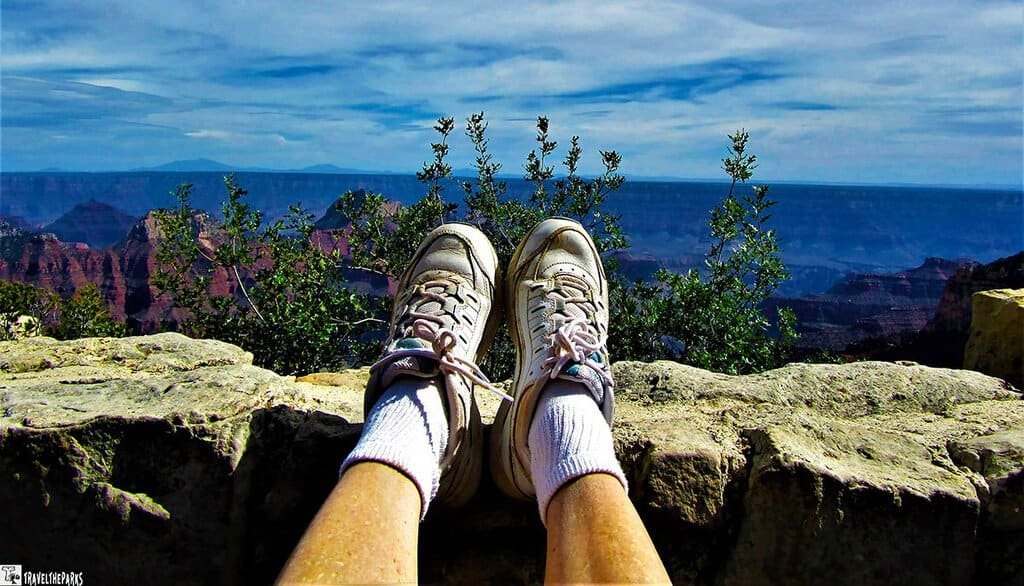
- Hiking Gear: Good walking or hiking shoes are important on the uneven trails. A trekking stick can also help on steeper sections. Bring layers and all-weather gear because conditions can change quickly at this elevation.
- Water & Elevation: Carry plenty of water and refill your bottles before heading out. The high elevation and dry air can catch up with you, so take your time and pace yourself.
- Pets: Pets have restrictions on trails and inside park buildings, so check the current regulations if you’re traveling with a dog.
Important: The information above reflects what we experienced or needed to know during our 2013 visit. The North Rim has undergone significant changes since then, including wildfire damage in 2025. Check current National Park Service information before planning your trip.
North Rim Grand Canyon Travel Guide – Getting There Made Easy
Getting to the North Rim takes a little more planning than visiting the South Rim. It is remote, and that’s part of what makes the experience so special. During our 2013 trip, we approached the North Rim from the Bryce Canyon area, and the drive became part of the adventure.
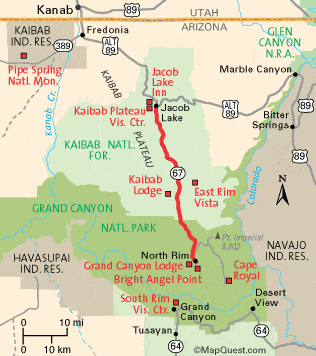
- From Bryce Canyon, plan on roughly five hours to reach the North Rim. We took UT-12 to US-89, passing through Kanab, before continuing along US-89A to Jacob Lake. From Jacob Lake, AZ-67 takes you south toward the North Rim.
- Kanab makes a convenient place to stop for fuel, food, or supplies before continuing toward the canyon.
- From Las Vegas: If you’re coming from Las Vegas, take I-15 north to AZ-389 east, then continue onto US-89A toward Kanab. From Kanab, follow US-89A to Jacob Lake and then take AZ-67 south to the North Rim.
- From the South Rim: Coming from the South Rim requires traveling around the eastern side of the Grand Canyon. Follow AZ-64 toward Cameron, then take US-89 north before connecting with US-89A and continuing toward Jacob Lake. From there, AZ-67 leads to the North Rim.
- Plan Ahead for Seasonal Access: The North Rim receives heavy winter snow, so access is seasonal. Road and facility opening dates can vary depending on weather and conditions. Before setting out, check the latest National Park Service road and weather information—especially if you’re traveling early or late in the season.
- One thing we really enjoyed about reaching the North Rim was that the journey felt like part of the adventure. The farther we traveled through the forest and away from the busier areas of the Southwest, the more anticipation built for that first glimpse of the canyon.
Exploring Jacob Lake—A Gateway to the North Rim Grand Canyon
Jacob Lake is one of those places that makes sense as a stop before heading toward the North Rim. During our 2013 trip, we used it as a chance to fuel up, grab anything we needed, and get ready for the drive into the Kaibab National Forest.
Located at the junction of US-89A and AZ-67, Jacob Lake is essentially the gateway to the North Rim. From here, AZ-67 heads south through the forest toward Grand Canyon National Park. The drive itself is beautiful, with towering ponderosa pines and open meadows along the way.
If you need food, fuel, or last-minute supplies, Jacob Lake is a convenient place to take care of those things before continuing south. There are also lodging options here if you prefer to stay outside the park. The area offers opportunities for hiking, mountain biking, and birdwatching, making it more than just a place to stop for gas.
For today’s travelers, Jacob Lake remains an important supply point. The National Park Service lists it as the closest location with fuel, lodging, a restaurant, and groceries outside the park, particularly important when North Rim services are limited.
For us, though, Jacob Lake was simply the last convenient stop before continuing toward the canyon. Once we turned onto AZ-67, the road carried us deeper into the forest, and the anticipation started building. We knew the Grand Canyon was waiting somewhere ahead.
North Rim Grand Canyon Travel Guide: Stop at Kaibab Plateau Visitor Center First
Before continuing toward the North Rim, we recommend making a stop at the Kaibab Plateau Visitor Center near the junction of US-89A and AZ-67 in Jacob Lake. During our 2013 visit, it was a great place to stretch our legs, have a picnic lunch, and get a feel for the forest we’d soon be driving through.
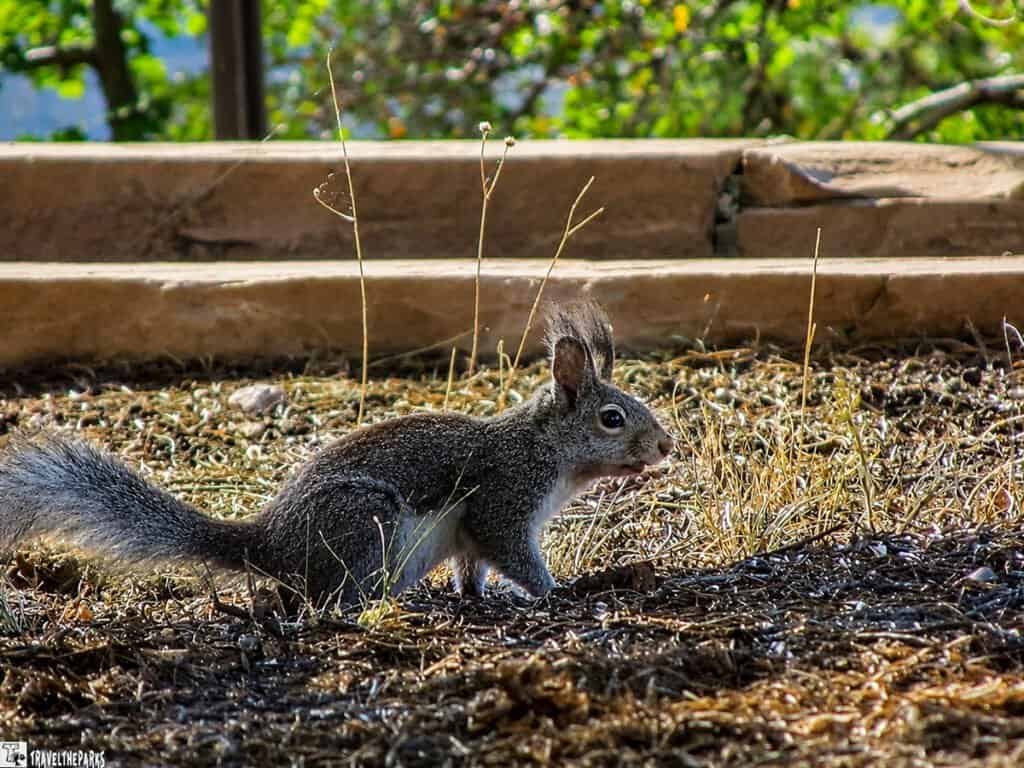
And, of course, we kept an eye out for the Abert’s squirrels.
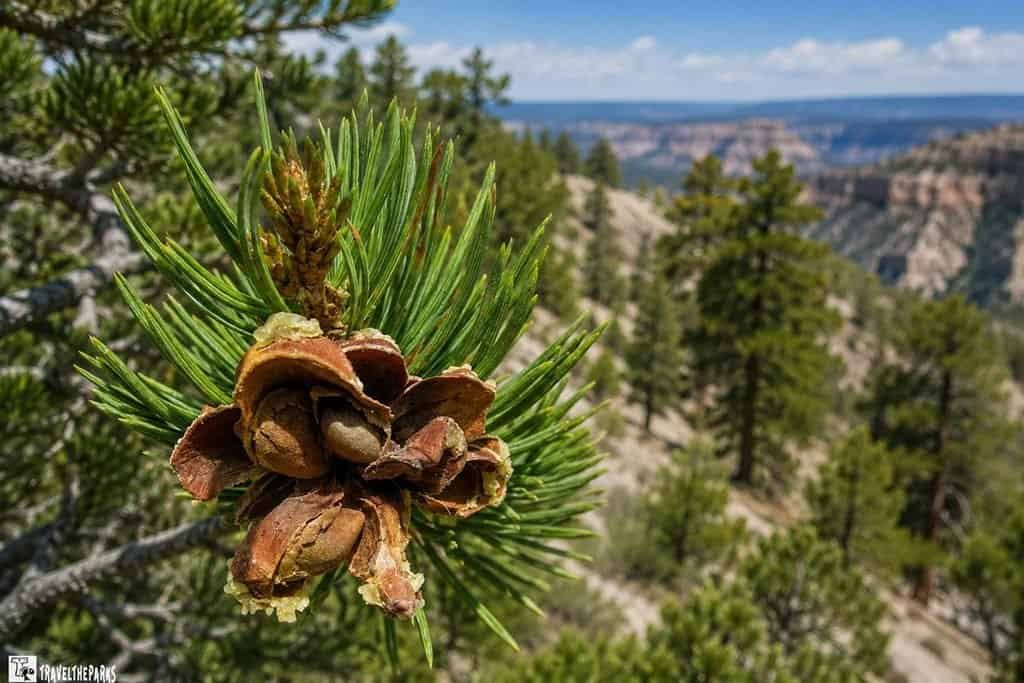
These squirrels are found in the North Kaibab region and are closely associated with the ponderosa pine forests. Their tufted ears and fluffy tails make them hard to mistake for other squirrels. We sat quietly near the picnic area watching for them, which turned out to be one of those unexpected little moments that made the drive more memorable.
One of the first things we noticed at the visitor center was the wonderful scent of ponderosa pine. After spending time around the displays and browsing the gift shop, we were ready to continue our drive toward the canyon.
We also recommend checking current road and weather conditions before leaving Jacob Lake. Once you head south on AZ-67, services become limited, so it’s a good idea to make sure you have fuel, water, food, and anything else you’ll need before continuing.
The drive from Jacob Lake to the North Rim takes about an hour, but don’t be in a hurry. The road winds through the Kaibab National Forest, and the scenery is beautiful. For us, the drive was part of the experience—the farther we traveled into the forest, the closer we knew we were getting to the North Rim.
Explore the Kaibab National Forest
From Jacob Lake, AZ-67 climbs steadily toward the North Rim, reaching elevations of around 9,000 feet along the way. This stretch of road, known as the Kaibab Plateau-North Rim Parkway, winds through a beautiful mixed-conifer forest.
During our 2013 drive, the forest seemed almost endless. Tall ponderosa pines surrounded us as we climbed higher, and the scenery changed gradually with the elevation. Then, a few miles down the road, the landscape began to look very different.
We came upon the area affected by the Castle Fire, which had burned through the forest after a lightning strike. For miles, we saw trees standing blackened and charred against the surrounding forest. The scene was almost otherworldly. It was beautiful in its own strange way, but also difficult to see.
What caught our attention, though, was what was happening beneath those burned trees. New green growth was already beginning to appear. Among all that black and gray, those tiny signs of green seemed to tell a different story—one of renewal. Nature was already beginning the process of rebuilding itself.
Fire can be devastating, but it is also a natural part of the forest’s life cycle. Seeing the contrast firsthand gave us a different appreciation for how these forests recover and change over time.
The Kaibab National Forest covers about 1.6 million acres and includes one of the largest contiguous ponderosa pine forests in the country. As we continued toward the North Rim, we moved through forests of ponderosa pine, Douglas fir, aspen, blue spruce, oak, pinyon pine, and juniper.
For us, the drive through the Kaibab wasn’t simply a way to reach the Grand Canyon. The changing forest, wildlife, and unexpected glimpse of nature’s resilience made the journey part of the adventure.
See Little Park Meadows and the Bison Herd
Just before entering the park, we rounded a bend and suddenly found ourselves looking out over Little Park Meadows. The wide, flat valley stretched out in front of us, covered in grass with the forest rising beyond it. It honestly looked like something straight out of the old Bonanza television show.
But what really caught our attention was the bison.
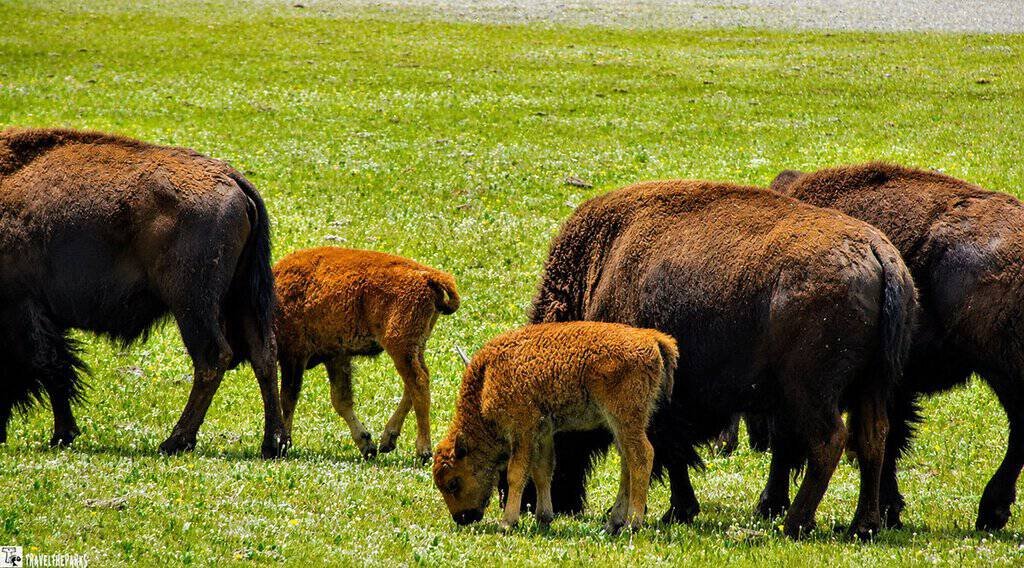
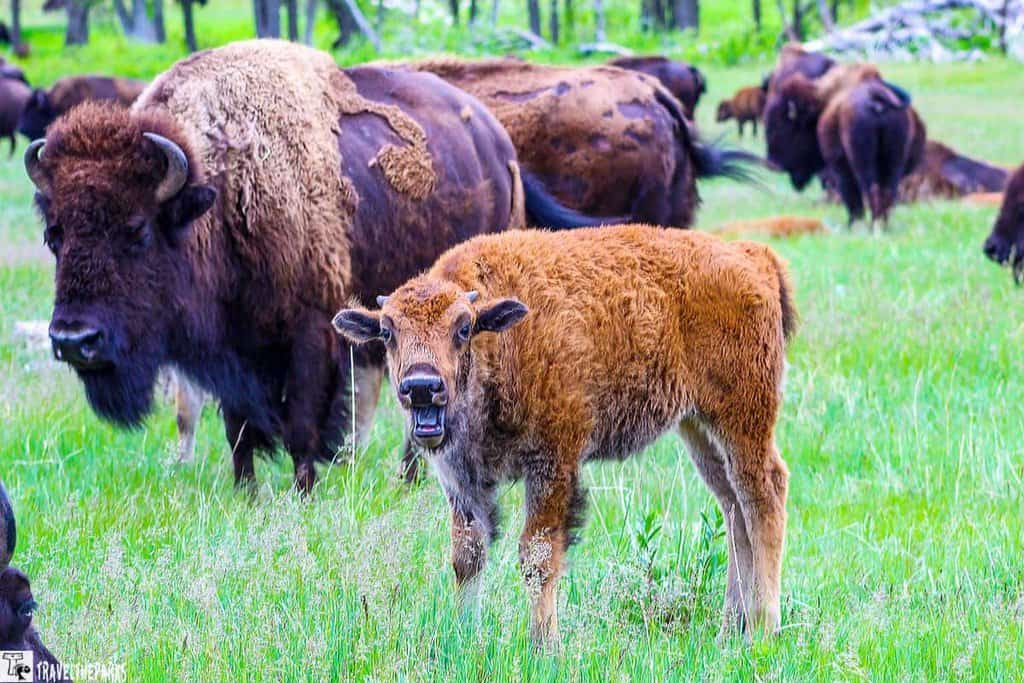
The House Rock Bison Herd was scattered across the meadow, and we could watch them moving through the grass from the road. Some were grazing peacefully, while others were running and playing with an energy that was impossible to ignore. Watching those big animals racing across the meadow with such speed and vigor was an unexpected highlight of our afternoon.
We weren’t the only ones fascinated by the scene. Cars slowed and pulled over along the road as people stopped to watch the herd. It could create quite a backup, but honestly, it was hard to blame anyone for wanting to stay and watch.
We could have sat there for much longer just watching the bison interact with one another. Their sheer size and strength were impressive, but seeing the younger ones running around the meadow with so much energy was what really made us smile.
This turned out to be one of those unplanned stops that became one of our favorite memories of the drive to the North Rim. Sometimes the best parts of a road trip are the things you never expected to see.
And for us, Little Park Meadows was definitely one of those stops.
Cape Royal Road: A Scenic Drive Through the North Rim
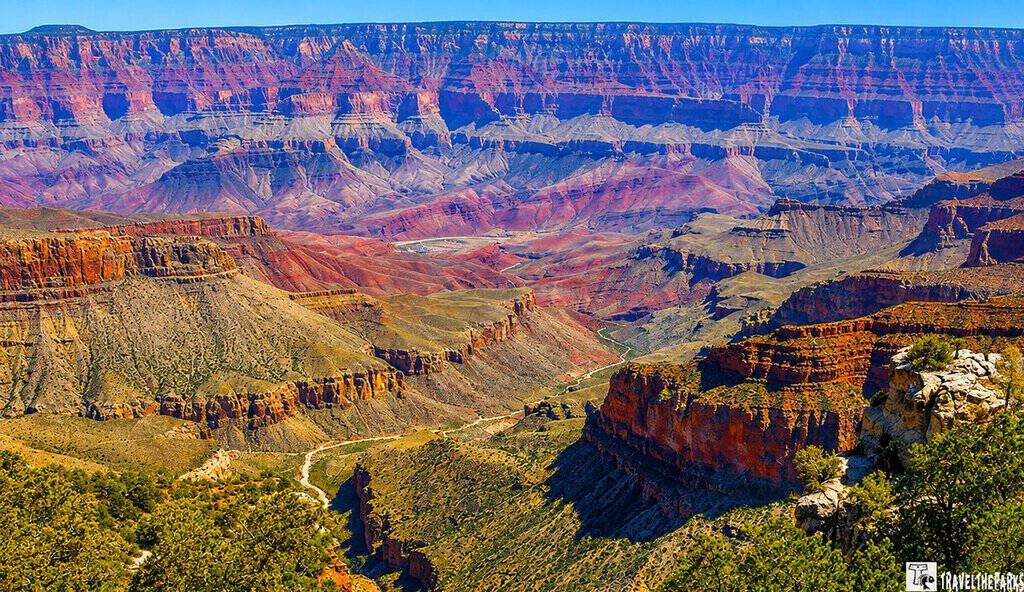
After making our way through the Kaibab Forest, we finally reached the North Rim of the Grand Canyon. The views were everything we had hoped for—and then some.
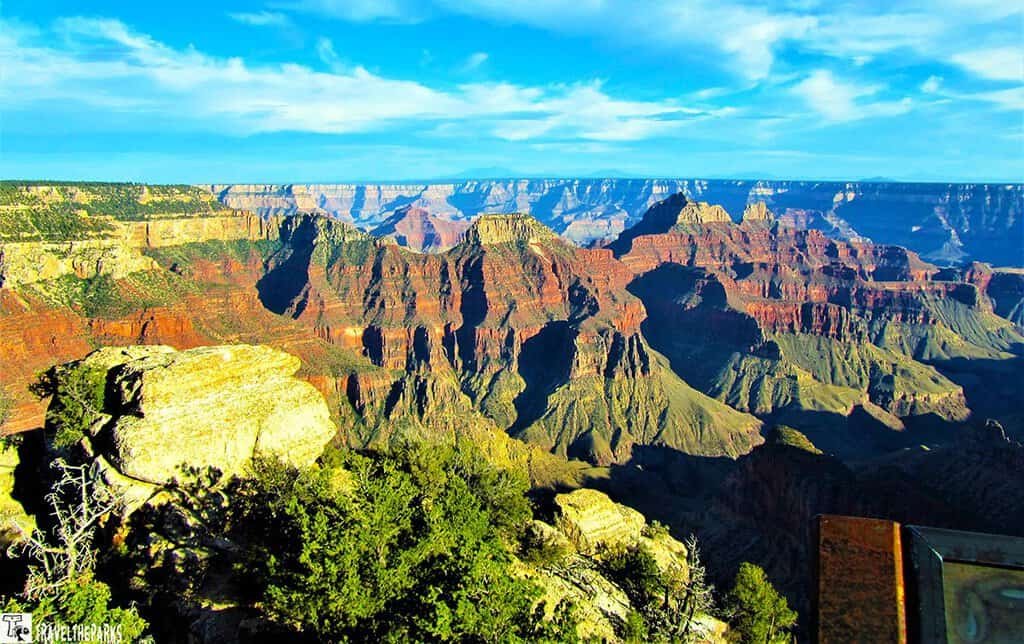
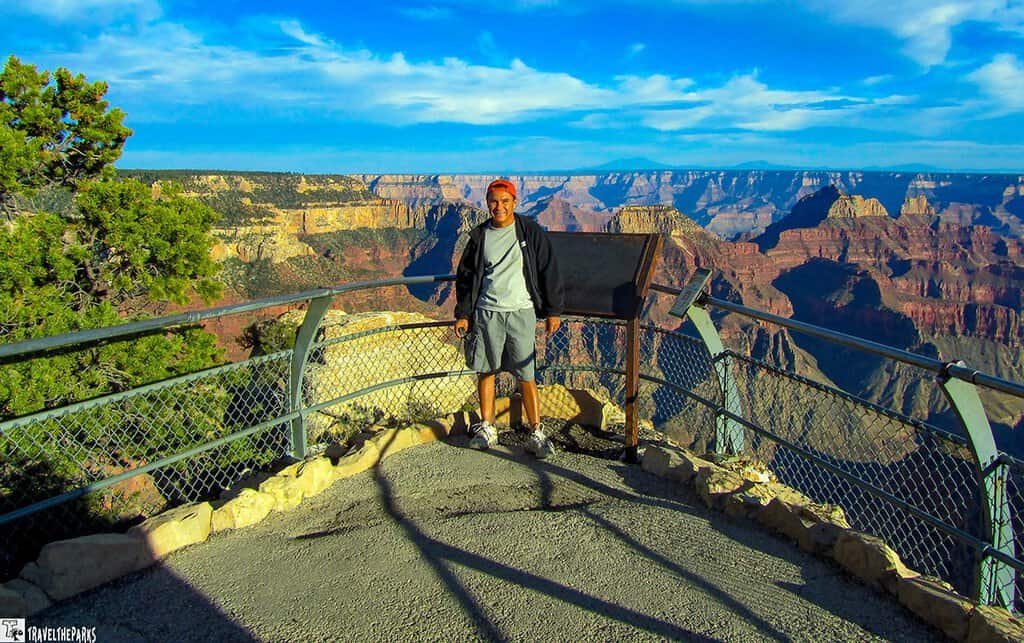
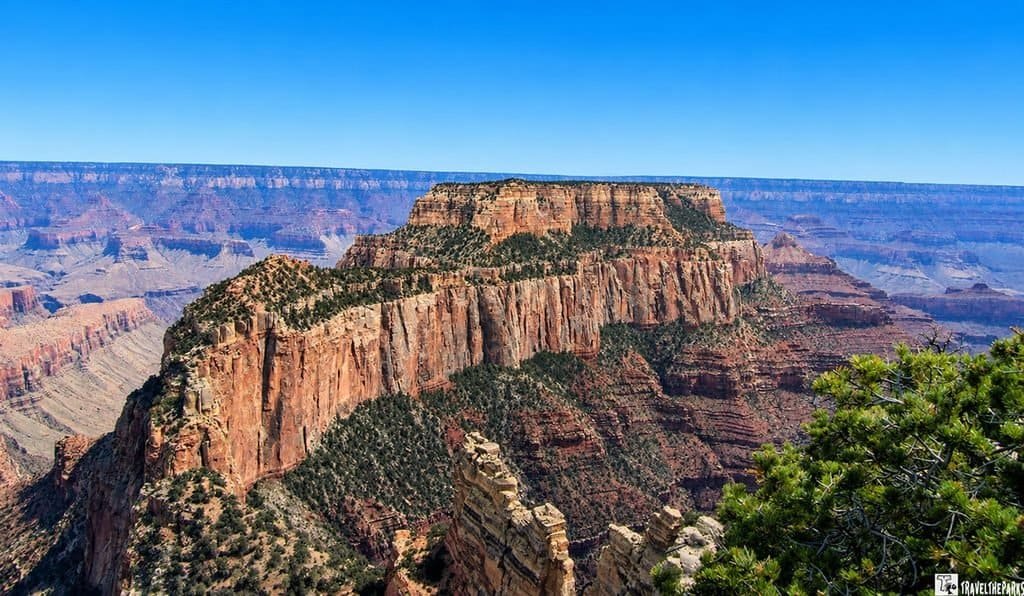
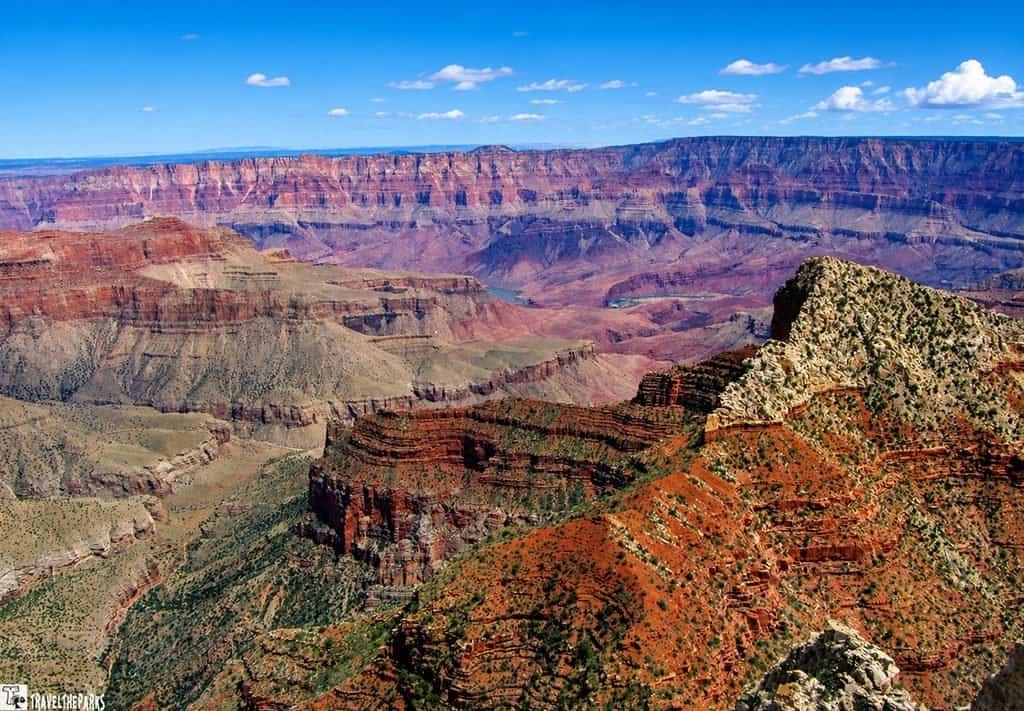
The North Rim gives you a completely different perspective of the canyon than the South Rim. The layers of rock seemed to stretch endlessly into the distance, with colors changing from one formation to the next. Far below, the Colorado River looked almost impossibly small, like a thin ribbon winding through the canyon.
We quickly realized that one day wasn’t going to be enough to take in everything, but we were determined to make the most of the time we had.
Scenic Drive Along Cape Royal Road—Must-See Stops on the North Rim
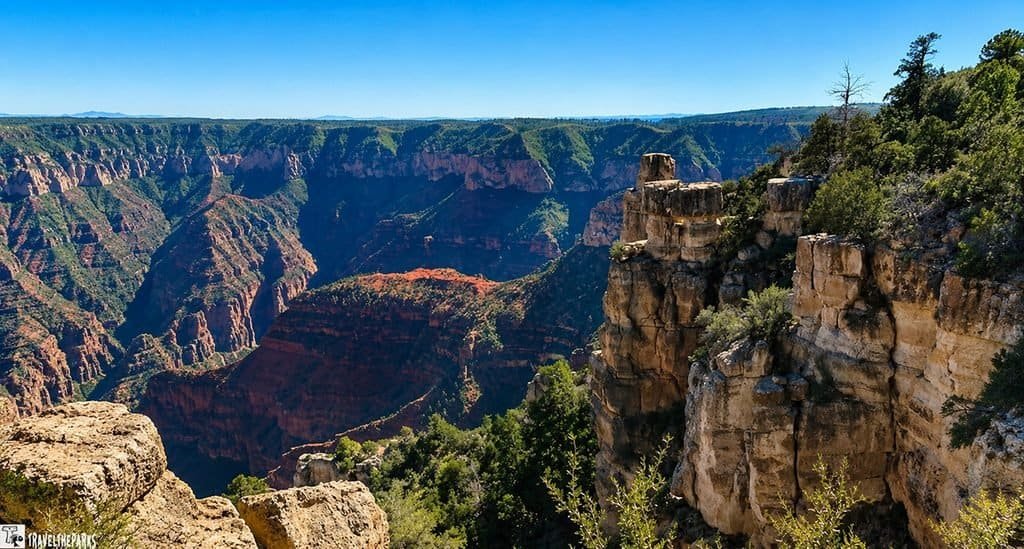
One of the best ways to explore the North Rim is along Cape Royal Road. During our 2013 visit, we followed the winding 23-mile road through forests of ponderosa pine, spruce, and cottonwood, stopping along the way whenever a viewpoint caught our attention.
Wildlife is abundant in this part of the park, so keep your eyes open as you drive. The road itself is part of the experience, with stretches of forest opening unexpectedly to reveal spectacular views of the canyon.
We also noticed the scars left by earlier wildfires along the drive. Fires in 2007 and 2009 had burned large sections of ponderosa pine forest, leaving behind stretches of blackened trees. Seeing the damage was sobering, especially knowing how long it would take for a forest like this to fully recover.
Our advice is simple: don’t rush Cape Royal Road. Give yourself plenty of time to stop at the overlooks and enjoy each one. We allowed about 45 minutes just to reach Cape Royal at the end of the road, but with all the stops along the way, you’ll want to budget considerably more time if you really want to explore.
Some of the viewpoints you’ll encounter include Point Imperial, Vista Encantada, Roosevelt Point, Walhalla Overlook, and Cape Royal. Each offers a different perspective, and that’s what makes this drive so much fun.
We found ourselves wondering what we’d see around the next bend—and more often than not, it was worth stopping for.
Picturesque Point Imperial
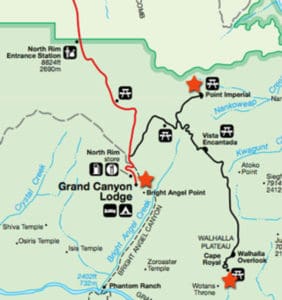
About five miles down Cape Royal Road, you’ll come to a Y-intersection. We turned toward Point Imperial, the highest viewpoint on the North Rim at 8,803 feet. The road climbs another three miles through the forest before reaching the overlook.
There is plenty of parking here, along with picnic tables and restrooms. From the parking area, a short, easy trail leads to the viewpoint. Guardrails along the trail make it easy to walk out and take in the scenery.
And what a view it is.
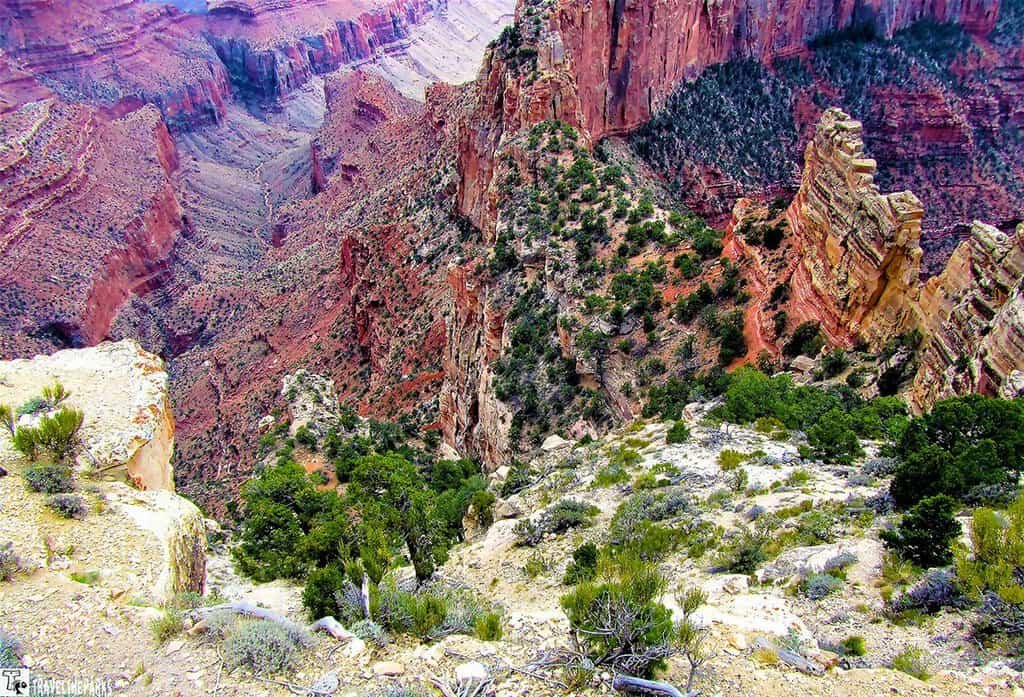
From Point Imperial, the canyon seems to stretch forever. We could see the rugged cliffs and plateaus of the northeastern Grand Canyon, with Navajo Mountain and Lake Powell visible in the distance to the east. Looking north, the Vermilion Cliffs and Grand Staircase-Escalante added even more layers to the landscape.
Standing that high above the canyon gave us a real sense of just how enormous this place is. We spent some time taking it all in before heading back down the road.
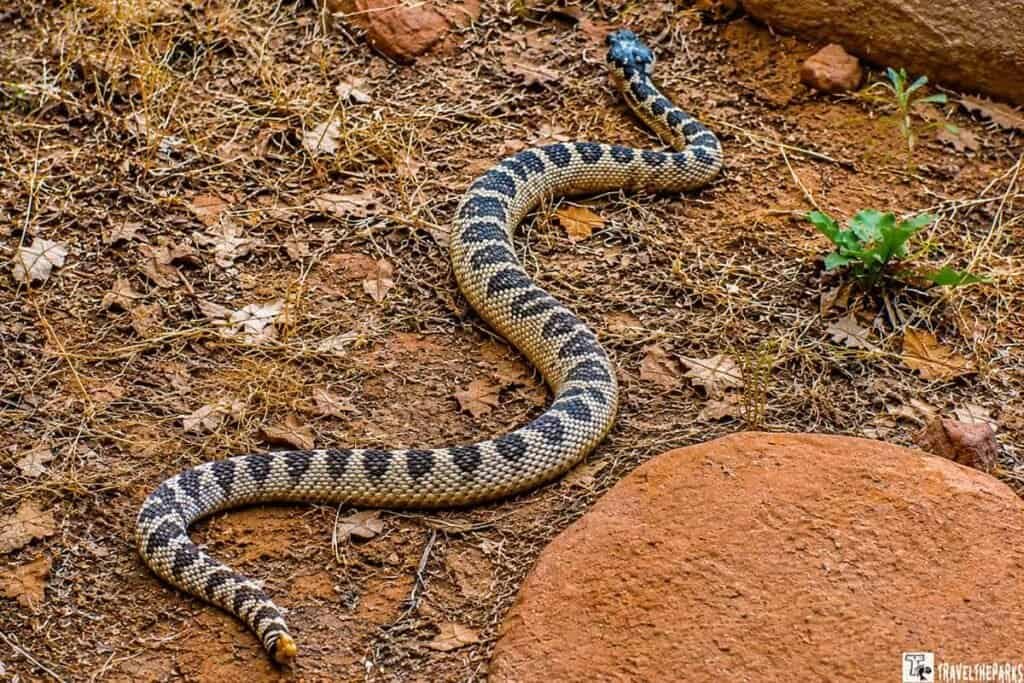
One thing we didn’t expect to see along the way was a rattlesnake in the road. Unfortunately, it had already been struck. I could understand how the driver couldn’t avoid it, but I still felt bad seeing it there. It was a reminder that we were traveling through a wild landscape, where wildlife is very much part of the scenery.
Vista Encantada Viewpoint
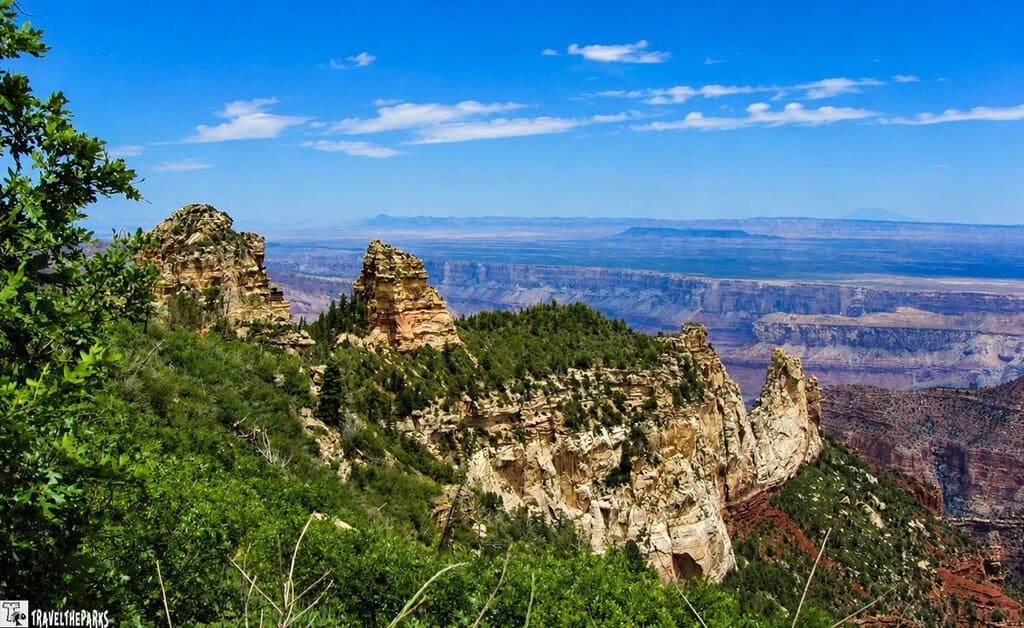
Continuing along Cape Royal Road, Vista Encantada makes a nice place to pull over and slow down for a while. There is a small parking area with picnic tables overlooking the Walhalla Plateau.
We thought this would be a great place to stop for a picnic and simply enjoy the surroundings. The view is different from Point Imperial, with the canyon rim framed by fir trees and the forest blending into the distant landscape.
If you’re spending the day exploring the North Rim, Vista Encantada is an easy stop to add to your route. We found that taking our time at these overlooks made the drive much more enjoyable. There was no reason to rush from one viewpoint to the next when every stop offered something different.
Historic Roosevelt Point
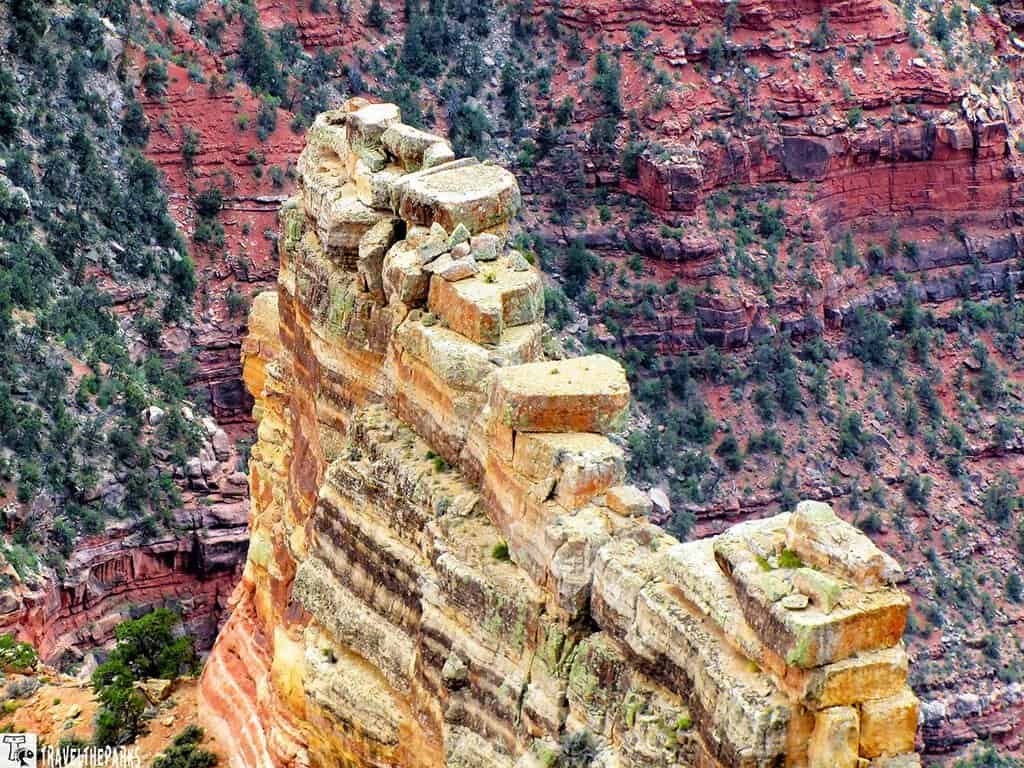
The next pullout along Cape Royal Road is Roosevelt Point, and this turned out to be another peaceful stop for us. The Roosevelt Point Trail is a short 0.3-mile loop at an elevation of about 8,470 feet. It is an easy, relaxing walk, and during our visit, wildflowers lined the trail as we made our way toward the rim.
Once we reached the overlook, we were rewarded with beautiful views across the canyon. Looking east, we could see toward the area where the Colorado and Little Colorado Rivers meet. The Walhalla Plateau and distant mountains added even more depth to the view.
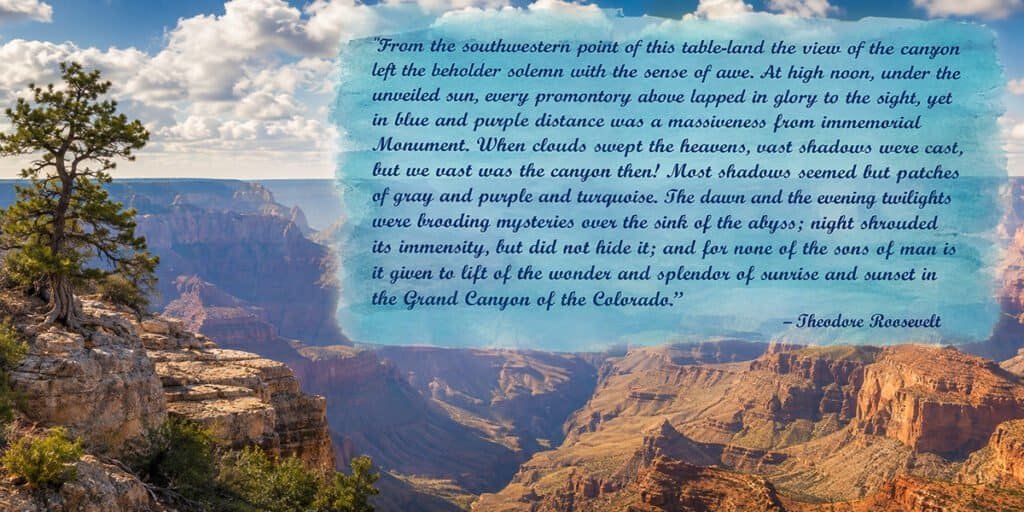
Roosevelt Point is named for President Theodore Roosevelt, who visited the Grand Canyon and was a strong advocate for protecting America’s natural landscapes. Standing at the overlook, it seemed fitting that his name would be attached to a place where the scenery makes it so easy to appreciate why these wild spaces are worth protecting.
The short trail, wildflowers, and expansive views made this an enjoyable stop without requiring a lot of time or effort. After exploring the overlook, we continued along Cape Royal Road to see what the next viewpoint would bring.
And, of course, Roosevelt had something to say about the Grand Canyon:
Walhalla Overlook: See the River
Walhalla Overlook sits at a lower elevation on the North Rim and offers a beautiful view of the Unkar Delta. There is a paved pullout on the east side of the road, making this an easy stop along Cape Royal Road.
A short, unpaved path leads toward the Walhalla Glades Pueblo, where excavations have uncovered the remains of ancient dwellings inhabited between about 1050 and 1150. It was fascinating to realize that people were living in this rugged landscape nearly a thousand years ago.
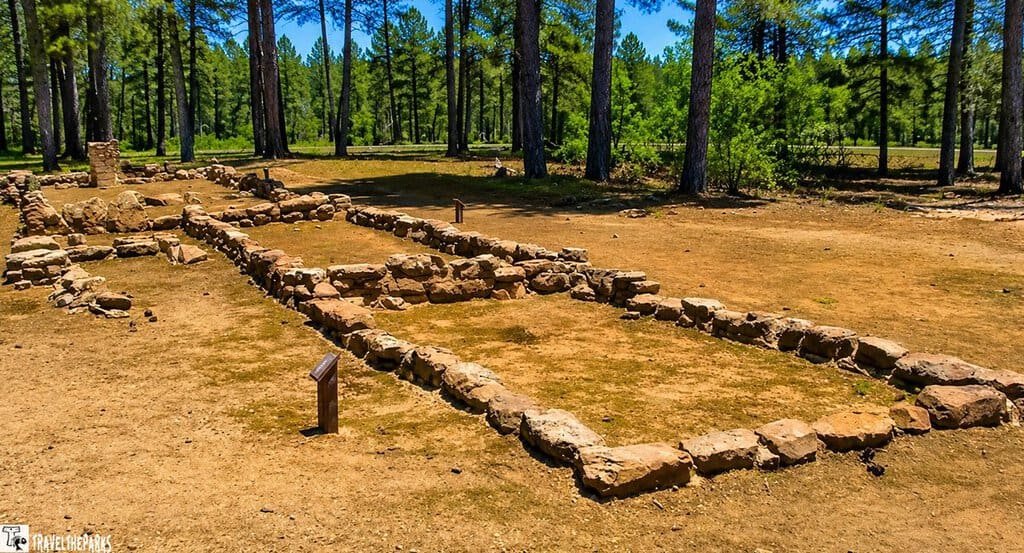
Across the road, you’ll find the trailhead for the Cliff Springs Trail. This short 1.1-mile hike descends through a small ravine and passes an ancient Puebloan granary along the way. The trail is rocky and boulder-strewn, but the real reward is waiting farther down.
We discovered a small spring emerging from an alcove tucked into the ravine. The cool water creates a little oasis for wildlife and mosses, and it felt like one of those places you could easily walk right past if you weren’t looking for it.
The trail isn’t particularly well marked, and we weren’t sure where the official endpoint was after reaching the spring. You can continue farther, but we decided this was a good place to turn around.
I love hikes that have little hidden surprises like this one. We weren’t expecting to find a spring tucked away in the canyon, and that’s what made the Cliff Springs Trail one of our favorite little discoveries along the North Rim.
Cape Royal & Look through the Angel’s Window
At the end of Cape Royal Road, we reached Cape Royal, the southernmost viewpoint on the North Rim. The short 0.6-mile round-trip trail to the overlook was well worth the walk.
The views were incredible, with Freya’s Castle, Vishnu Temple, and Wotan’s Throne stretching across the canyon. Below us, the Colorado River and Unkar Delta added even more depth to the panorama.
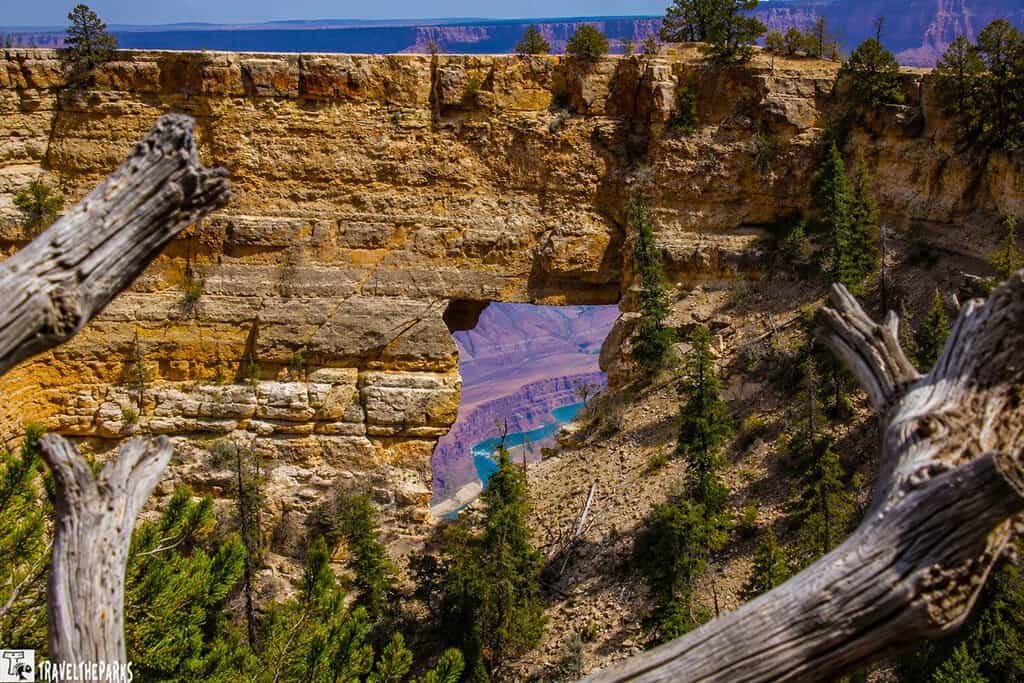
Be sure to take the side trail to Angel’s Window. The natural arch frames the canyon and the Colorado River far below, creating an entirely different perspective.
After a day filled with spectacular overlooks, Angel’s Window felt like the perfect finale. We could have stayed there much longer, simply taking in the scenery.
Sometimes there really aren’t enough words—or photographs—to capture the feeling of standing at the edge of the Grand Canyon. You simply have to be there.
North Rim Grand Canyon Travel Guide: Hike to Bright Angel Point
The Bright Angel Point Trail starts near the Visitor Center and follows a paved path for about a half-mile round trip from the lodge. It may be short, but don’t let the distance fool you. There is a steep 200-foot elevation gain, and the trail reaches an elevation of about 8,161 feet.
I’ll admit this trail made me a little nervous.
If you’re afraid of heights, some sections can be intimidating. The trail narrows in places, with steep drop-offs on either side, and strong winds can make those exposed sections feel even more precarious. I made it to the point by clinging to the rocks and doing my best not to look down. Let’s just say I was very focused on where I was putting my feet!
Thankfully, the views at the end made all that nervousness worthwhile.
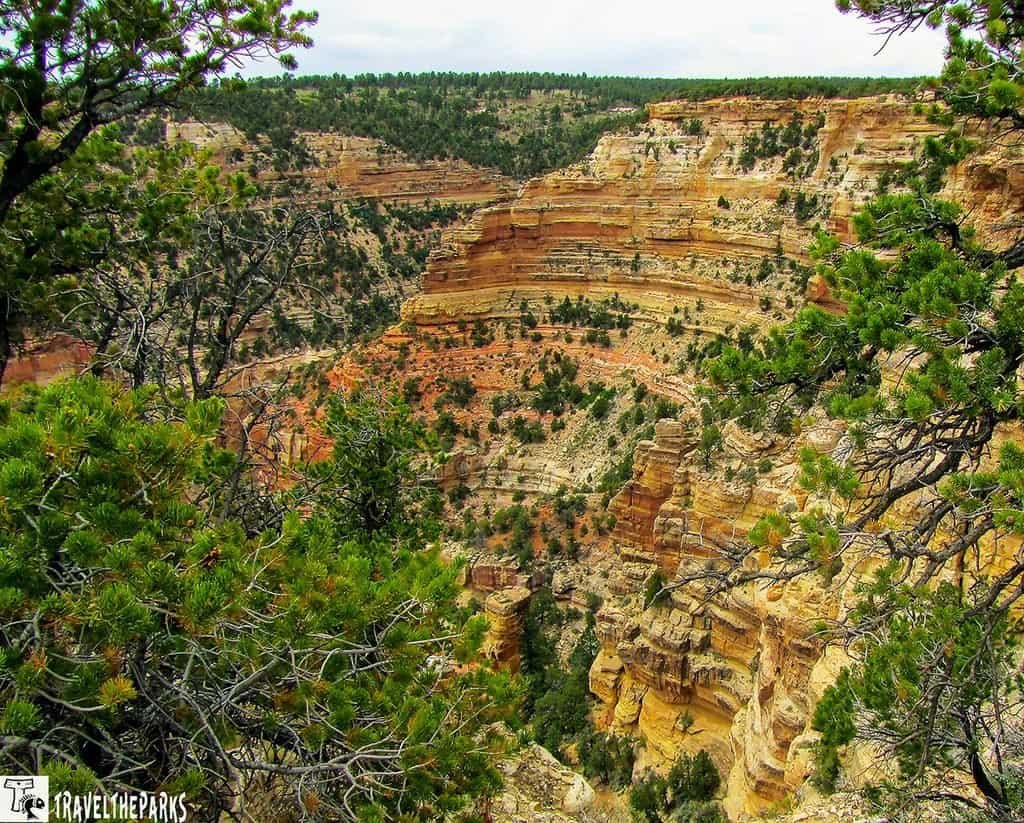
From Bright Angel Point, we could look west over the end of The Transept, with Oza Butte standing prominently in the distance and Manu Temple beyond. Looking south, Bright Angel Canyon stretched out below us, surrounded by a jagged ridge topped by Deva Temple, Brahma Temple, and Zoroaster Temple.
To the east, the broad Walhalla Plateau filled the view. On a calm day, you may even be able to hear Roaring Springs, more than 3,000 feet below the rim.
On the way back, we took the left fork that leads below the lodge. It was a nice way to finish the walk and gave us another perspective of the area.
Was I still nervous on the return trip? Absolutely. But I’d do it again for that view.
North Rim Visitor Center
During our 2013 visit, the North Rim Visitor Center was a useful first stop before heading out to explore. We picked up maps and information at the ranger desk, checked out the exhibits, and browsed the gift shop. The interactive displays were especially interesting if, like us, you enjoy learning about the geology behind the landscape you’re standing in.
We also picked up information about the ranger-led programs and activities happening during our visit. Public restrooms were available in the building, which made this an easy place to stop before setting off on the trails.
The Visitor Center is also a good place to get oriented. The North Rim has plenty of overlooks and trails, and having a map made it easier for us to figure out how we wanted to spend our limited time.
Travel Note: Our visit was in 2013, so visitor center hours, services, exhibits, and available programs may have changed. Check the National Park Service for current information before your trip.
Canyon Mule Tour
A mule ride was another option we considered during our North Rim visit. At the time, visitors could choose between a 1-hour Rim Ride and a 3-hour Supai Tunnel Ride.
The shorter ride stayed mostly on forested trails away from the canyon rim, so canyon views were limited. The longer ride went farther into the canyon along narrow trails and included a stop at Supai Tunnel, where freshwater and restrooms were available before beginning the return journey.
For anyone who would rather experience the canyon without committing to a long hike, a mule ride offered a very different way to see the landscape. The opportunity to travel into the canyon on trails that would otherwise require a strenuous hike sounded like quite an adventure.
Important: These mule ride descriptions reflect the options available during our 2013 experience. Mule operations and routes can change, so check current National Park Service information before planning a ride.
North Rim Grand Canyon Travel Guide: Where to Stay – Our 2013 Experience
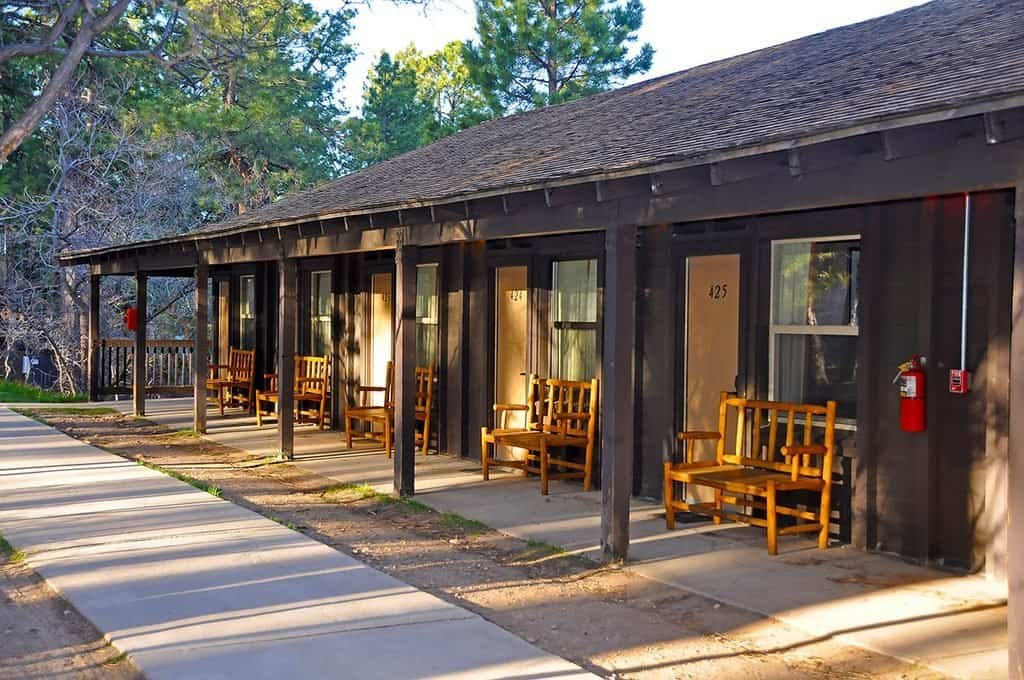
We decided to stay one night at the North Rim during our 2013 visit, and I’m glad we did. We had originally booked a cabin, but a change in our schedule meant we had to switch our reservation to a hotel room.
Our room had a queen-sized bed, a small refrigerator, and a private bathroom. The cabins are a different option, and some have views of the canyon, while the hotel rooms do not. Parking was conveniently located across the street, making it easy to come and go.
During the day, the North Rim could be surprisingly busy, with tour buses and plenty of visitors arriving to take in the views. But something magical happened as evening approached. The crowds thinned out, the noise faded, and the North Rim became peaceful and quiet.
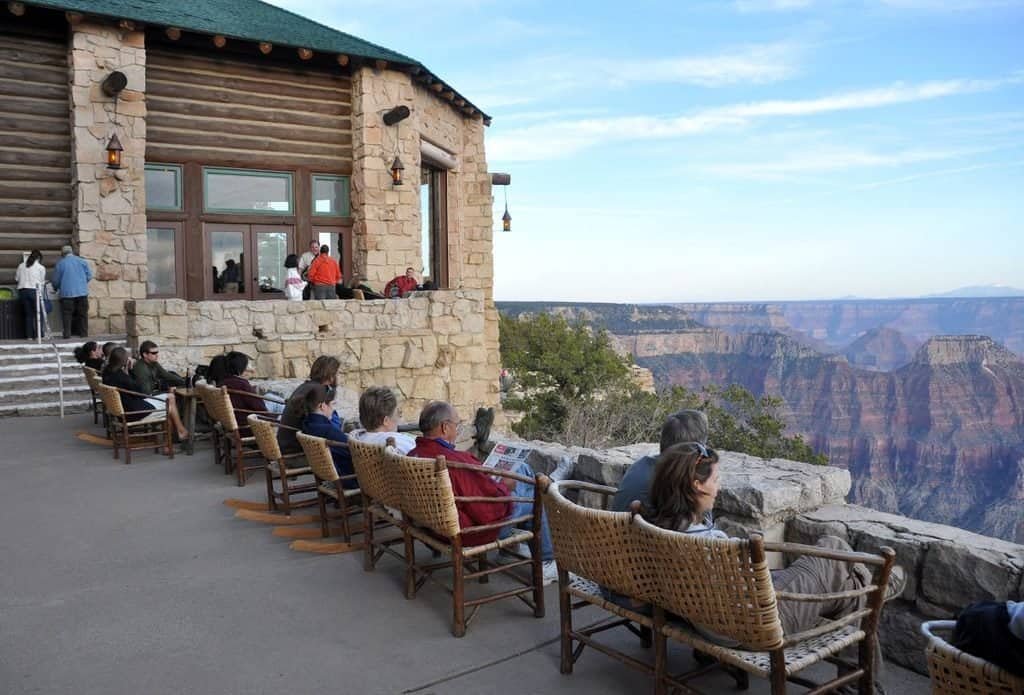
One of our favorite places to spend that time was the lodge veranda. We could sit in the Adirondack chairs near the canyon rim, enjoy an adult beverage, and watch the light change across the canyon. After a busy day of exploring, it was the perfect place to slow down and simply enjoy where we were.
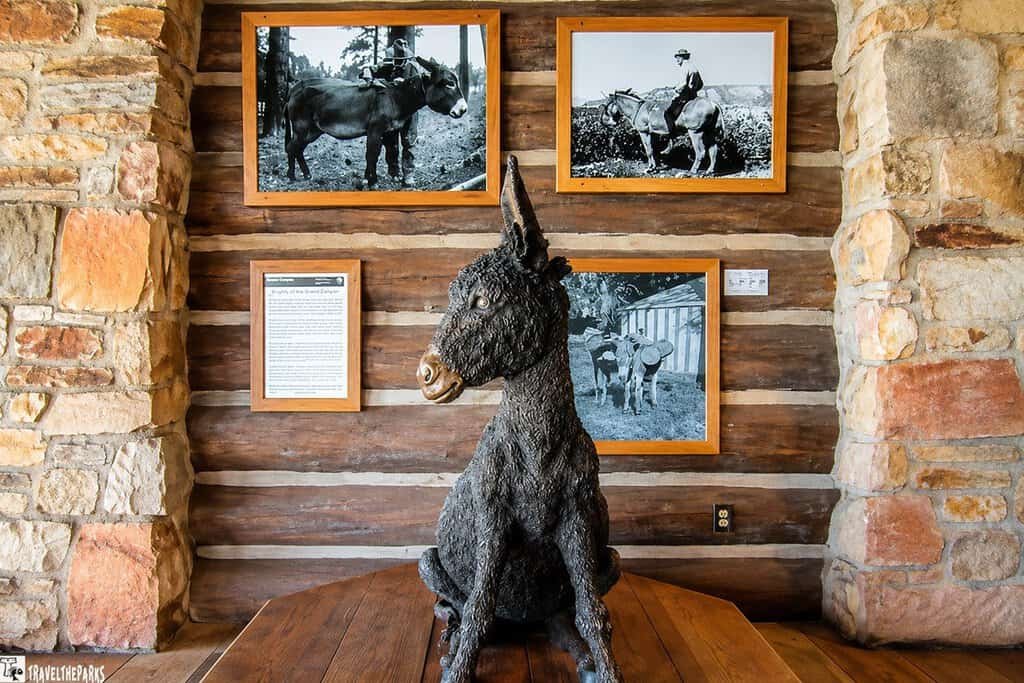
And don’t forget to look for Brighty while you’re there. The statue of the little burro is a fun stop, especially if you’ve read Marguerite Henry’s Brighty of the Grand Canyon. Naturally, we had to give Brighty’s nose a rub before moving on.
Important 2026 Update: We stayed at the North Rim in 2013. Overnight lodging is not available on the North Rim during the 2026 season following the 2025 wildfire. If you’re planning a current visit, you’ll need to look for accommodations outside the park.
Grand Canyon Lodge: A Historic Landmark We Remember
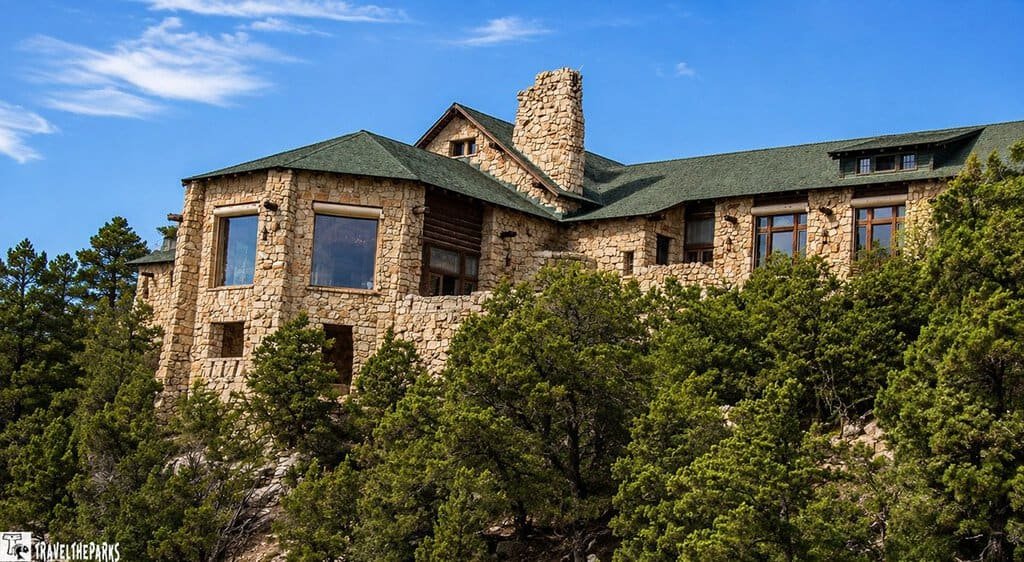
During our 2013 visit, Grand Canyon Lodge was one of those places that immediately made an impression. Perched above the canyon near Bright Angel Point, the lodge was a National Historic Landmark and an important part of the North Rim experience.
The original lodge was constructed in 1927–28 and designed by architect Gilbert Stanley Underwood. After a fire destroyed the main building and several cabins in 1932, the lodge was rebuilt in 1937. Native stone and timber gave the building a rustic character that fit beautifully with the surrounding forest and rocky landscape.
We loved the way the lodge brought everyone together. There were comfortable indoor spaces as well as outdoor seating where visitors could relax and take in the spectacular canyon views. The large veranda was especially memorable, with its Adirondack chairs positioned right along the rim.
After spending the day exploring trails and overlooks, sitting there and looking out across the canyon was the perfect way to slow down. The lodge didn’t feel like just a place to stay—it felt like part of the North Rim experience itself.
Remembering Grand Canyon Lodge
Our photographs and memories of Grand Canyon Lodge are from our 2013 visit. Sadly, the historic lodge was destroyed in the 2025 Dragon Bravo Fire. That makes this part of our trip especially meaningful to look back on.
The lodge we remember was more than a beautiful building. It was a gathering place, a historic landmark, and one of the places that helped make our North Rim visit so special.
Important North Rim Grand Canyon Travel Guide: Overnight lodging is not available on the North Rim during the 2026 season. Conditions and services can change, so check the National Park Service for the latest information when planning your visit.
Staying at the North Rim Campground
The first thing we noticed when we arrived at the North Rim Campground was the fresh scent of ponderosa pine. Campsites were spread throughout the trees, and being tucked among the forest gave us a wonderful sense of privacy.
The campground was also conveniently located near the canyon rim, with access to several trails. One of our favorite things about staying there was how easy it was to walk out toward the rim to watch the sunset or sunrise. After a day of exploring, being able to step away from the campsite and see the canyon in the changing light was pretty special.
If you plan to camp at the North Rim, reservations are important. During our visit, campsites filled well in advance, so we recommend planning ahead rather than hoping to find a site when you arrive.
The campground also had a general store stocked with many of the things campers might need, from coffee and fresh produce to camping supplies. There were also Wi-Fi, an ATM, coin-operated showers, and laundry facilities. We actually stopped at the general store to use the Wi-Fi during our stay.
Important 2026 Update: This section describes the campground as we experienced it in 2013. The North Rim Campground reopened June 1, 2026, following the 2025 wildfire, but services and conditions may differ from what we remember. Check current National Park Service and Recreation.gov information before making reservations.
North Rim Grand Canyon Travel Guide: Dining Options
When we stayed at Grand Canyon Lodge in 2013, dining options on the North Rim were limited. Unless we picked up something at the lodge deli or brought our own food, the lodge restaurant was our main option for a sit-down meal.
Because there weren’t many alternatives nearby, we were advised to make dinner reservations well ahead of our visit. That turned out to be good advice.
For us, this was one of those little pieces of trip planning that made a difference. When you’re staying in such a remote location, you can’t always count on finding another restaurant just down the road. Planning ahead meant we could enjoy our evening without worrying about where we’d eat.
Important North Rim Grand Canyon Travel Guide: Our dining experience reflects the North Rim as we found it in 2013. Restaurant availability and services have changed since then, particularly following the 2025 wildfire. Check current park information before your trip.
The Grand Canyon Cookout Experience
One of the dining experiences we enjoyed during our 2013 visit was the Grand Canyon Cookout Experience, a traditional chuckwagon-style dinner. Guests took a tram out to the campground, where a large tent was set up behind the gas station.
The buffet had plenty to choose from, including barbecue chicken, beef brisket, potatoes and sweet potatoes, corn on the cob, beans, vegetable stew, biscuits, salad, and fruit cobbler. Of course, there were fresh cookies, too. During dinner, entertainers performed songs celebrating the history and character of the North Rim, adding to the whole chuckwagon atmosphere.
It was a fun way to spend an evening and definitely different from simply sitting down in a restaurant.
Grab and Go at Deli in the Pines
Sometimes you don’t need a fancy dinner. We grabbed a quick meal from Deli in the Pines, which had plenty of convenient choices for hikers and travelers. There were sandwiches, fresh and prepared salads, pizza, elk chili, fruit, cookies, chips, and energy bars.
We decided on a few slices of pizza and took them outside to the veranda. Sitting there with our pizza while watching the sunset over the canyon was one of those simple moments that ended up being a favorite memory of the trip.
Grab a Coffee or Drink at Rough Rider Saloon
The Rough Rider Saloon had a fun Old West atmosphere with a Teddy Roosevelt theme. We found it to be a comfortable place to grab a drink and relax after exploring the North Rim.
It was also a convenient breakfast stop, with items such as burritos, pastries, muffins, bagels, and a selection of coffee drinks. Being able to take a drink outside and sit on the balcony overlooking the canyon made it even better.
Grand Canyon Lodge Dining Room: The View Is Everything
We also had breakfast in the Grand Canyon Lodge Dining Room, and the setting was hard to beat. We skipped the buffet and ordered a simple breakfast from the à la carte menu instead.
The food was good, but honestly, the view was the real star of the morning. Watching the first sunlight reach across the canyon walls and bring out all those incredible colors was unforgettable.
The dining room could get busy, particularly when tour groups arrived, so during our visit we found it worthwhile to plan around the crowds.
Important 2026 Update: These dining experiences describe what we enjoyed during our 2013 visit. The 2025 wildfire significantly changed services on the North Rim, so restaurant and food-service options described here should not be assumed to be available today. Check current National Park Service information before your trip.
Final Thoughts: North Rim Grand Canyon Travel Guide: Exploring in 1 Day
Exploring the North Rim Grand Canyon in 1 day gave us just enough time to see the highlights, but we definitely left wishing we had more time. From the drive through the Kaibab National Forest to the incredible overlooks along Cape Royal Road, every part of the day offered something different.
Our 2013 visit was filled with those little moments we still remember—the bison running through Little Park Meadows, the green shoots appearing among the burned trees, discovering the spring along Cliff Springs Trail, and watching the canyon walls light up at sunrise and sunset. Those unexpected moments are often what make a trip stick with you long after you’ve returned home.
If you’re planning a Southwest road trip, we think the North Rim deserves a place on your Southwest Bucket List Itinerary. One day can give you a wonderful introduction, but if you have the time, slowing down and spending another day exploring would be even better.
Keep in mind that our experience was in 2013, and the North Rim has changed significantly since then, particularly following the 2025 wildfire. Use our story as a look back at what we experienced, and check current National Park Service information when planning your own visit.
Have you explored the North Rim Grand Canyon? What did you think? We’d love to hear about your experience in the comments below!