Table of Contents
Updated August 2026
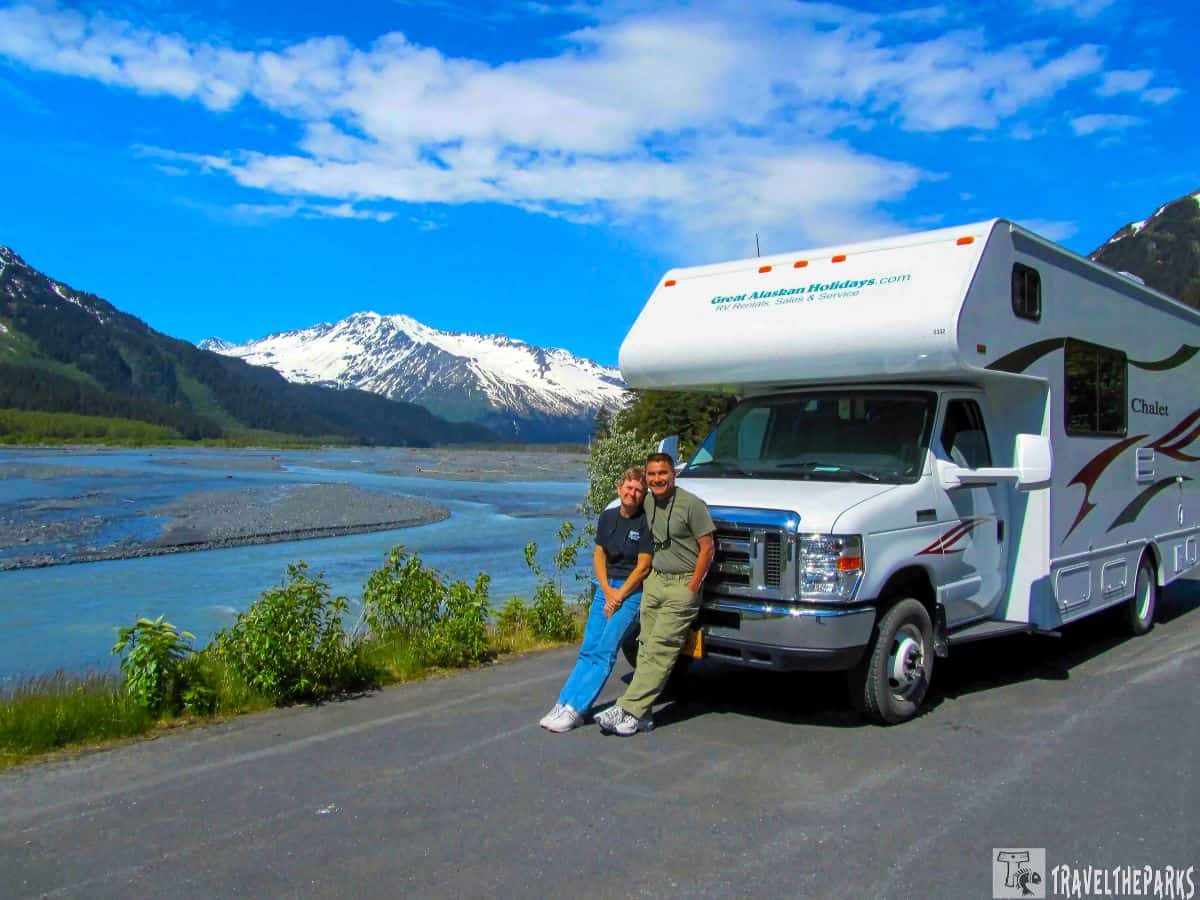
The Alaska adventure continues! As part of our Alaska dream vacation, we had our RV packed, the sun was shining, and we were ready for another unforgettable stop: Exit Glacier in Kenai Fjords National Park.
Located just off the famous Seward Highway, Exit Glacier makes an easy day trip to Exit Glacier in Kenai Fjords National Park. The road can get busy during the summer rush, but the payoff is worth it. Exit Glacier is one of the most accessible glaciers in Alaska, giving you a chance to get surprisingly close to the ice without heading deep into the backcountry.
Whether you have time for a quick stop or want to explore the trails, there are plenty of things to do at Exit Glacier. We were excited to see this incredible piece of Kenai Fjords up close and find out why it deserves a spot on an Alaska road trip.
This post may contain affiliate links, meaning if you purchase something through one of these links, we may earn a small commission at no extra cost to you! Read the full disclosure policy here.

Overview of Exit Glacier in Kenai Fjords National Park
The Kenai Fjords National Park encompasses nearly 65% of the Harding Icefield. Exit Glacier Road is the only road-accessible portion of the Kenai Fjords National Park.
Exit Glacier is a prominent valley glacier in Alaska, flowing from the Harding Icefield in the Kenai Mountains. It gained its name in 1968 when it served as the “exit” route for the first recorded crossing of the Harding Icefield. This glacier is a striking example of the natural beauty of this rugged landscape of Alaska. Visitors often come to witness its massive ice formations in such a unique environment. The glacier’s movement shapes the surrounding valley, showcasing the power of nature. Exploring Exit Glacier offered us wonderful insight into glacial processes and the impact of climate change on these majestic ice bodies.


How to Get to Exit Glacier in Kenai Fjords National Park
Getting to Exit Glacier in Kenai Fjords National Park is surprisingly easy. No seaplane or bush pilot required! From Seward, head north on the Seward Highway for about 3.7 miles and watch for the turnoff to Exit Glacier Road. Follow the signs, and you’ll soon be on your way to the glacier.
If you’re coming from Anchorage like we were, plan on about two hours for the roughly 130-mile drive to Seward. And don’t rush it. The Seward Highway is one of those drives where the scenery is part of the experience. Keep your camera handy because you never know when a moose, bear, or eagle might make an appearance.
Once you reach Seward, Exit Glacier Road follows the Resurrection River toward the glacier. The road offers beautiful mountain views along the way and eventually brings you to the parking area near the Exit Glacier Nature Center.

Exit Glacier is one of Alaska’s most accessible road-connected glaciers, which is a big part of its appeal. June, July, and August are popular months to visit because the weather is generally better and more trails are accessible. Summer is also when you’ll find the most visitors.
We pulled into the parking lot at the end of Exit Glacier Road bright and early, and our rented RV fit just fine. That early arrival turned out to be a good decision. During the busy summer months, the parking area can fill up as visitors, tour buses, and cruise passengers arrive throughout the day.
Our tip: If you’re visiting Exit Glacier during peak season, get there early. You’ll have an easier time finding parking and a much quieter start to your visit. Plus, there’s something pretty special about seeing the glacier before the crowds arrive.
Important Information to Know before You Visit Exit Glacier
A little planning can make your visit to Exit Glacier in Kenai Fjords National Park much easier. Here are a few things we think are worth knowing before you go.
- No entrance fee: There is no entrance fee to visit Exit Glacier. We still like to support our National Parks by purchasing an America the Beautiful Pass. It provides access to more than 2,000 federal recreation sites for one year. The annual pass is currently $80.
- Exit Glacier Nature Center: The Nature Center is open seasonally, generally from May through September. Hours can change, so check the National Park Service website before your visit.
- When to visit: Summer is the most popular time to visit Exit Glacier.
- June through September generally offers the best combination of longer daylight hours, milder weather, and better trail conditions. That said, visiting during the shoulder seasons can mean fewer people and a completely different experience.
- Spring and fall: May and early June can bring muddy trails and lingering snow. September and October can be beautiful, especially with fall colors, but changing weather can make trail conditions unpredictable.
- Winter: Exit Glacier is accessible during winter, but access and services are much more limited. Snow and ice can make trails difficult or impossible to reach. Winter visitors should be prepared for Alaskan conditions and check current park information before heading out.
- Facilities: You’ll find parking, restrooms, and the Exit Glacier Nature Center in the developed area. Don’t count on finding restaurants or stores nearby, so bring your own snacks and water.
- Pets: Pets are allowed on a leash in some developed areas around Exit Glacier, but they are not permitted on certain trails, including the Harding Icefield Trail. Always check current NPS regulations before bringing your four-legged travel companion.
One important thing to remember: Alaska weather can change quickly. Even on a beautiful summer day, bring layers and be prepared for cooler temperatures, rain, or changing trail conditions.

Things to Do at Exit Glacier: Explore the Nature Center
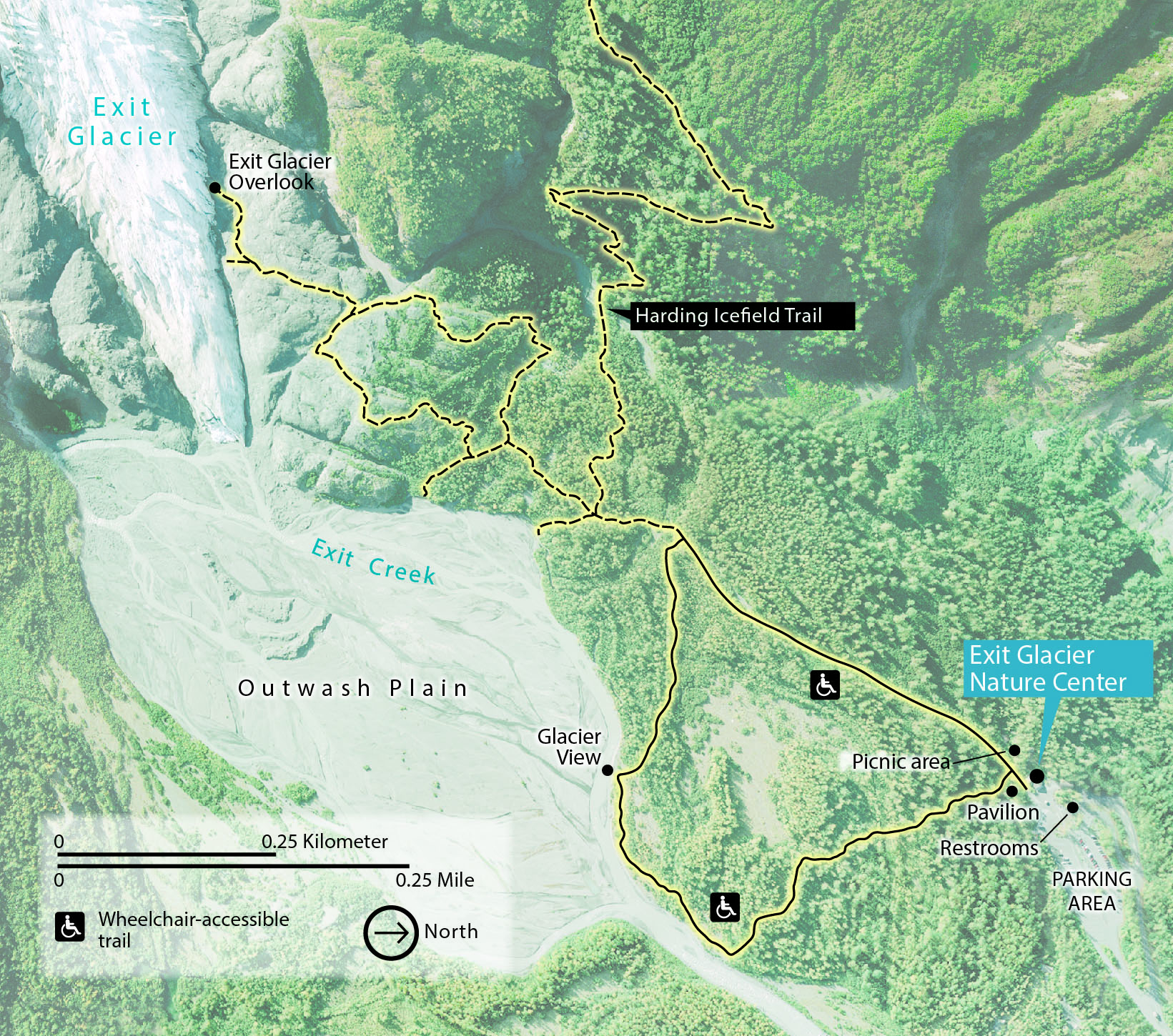
We started our visit with the short walk from the parking area to the Exit Glacier Nature Center. This is a good place to begin your adventure, especially if it’s your first visit. Stop in, talk with a ranger, and check the latest trail and weather conditions before heading out.
The Nature Center is also a great place to learn more about the glacier and the landscape around it. Inside, you’ll find exhibits covering the area’s glacial geology, history, and wildlife. Interactive displays can help you understand what you’re seeing outside and decide which trail makes the most sense for your visit.
Be sure to grab a trail map before you head out. Having a map in hand makes it much easier to get your bearings once you’re on the trails.
We decided to take things a little differently and used a self-guided audio tour through The Alaska App, narrated by the Park Service’s chief interpretive ranger. It gave us another way to learn about the glacier as we explored.

Restrooms, Water, and What to Bring
The Nature Center area also has clean restrooms with flush toilets. There’s a place to fill your reusable water bottle, so take advantage of it before starting a longer hike.
If you’re planning to hike, especially the Harding Icefield Trail, come prepared. Bring plenty of water and some quick, easy snacks. A pair of trekking poles can be helpful on the steeper sections, and you’ll want to be prepared for Alaska’s wildlife as well.
Bug spray can also be useful during the warmer months. When we visited in June, the cooler temperatures meant mosquitoes weren’t a problem for us. Conditions can vary, though, so it’s better to have some along than wish you did.
Our advice: Don’t rush past the Nature Center just because you’re anxious to see the glacier. Spending a few minutes here gave us useful information and helped us get more out of the trails and the experience that followed.

Day Trip to Exit Glacier in Kenai Fjords NP: Join a Ranger-Led Tour
If you have some extra time during your day trip to Exit Glacier in Kenai Fjords National Park, consider joining a ranger-led walk. We think it’s one of the best ways to learn more about the glacier while taking in the scenery.
Rangers lead walks toward the Glacier View area, pointing out interesting features along the way and sharing stories about the glacier, its history, and the surrounding landscape. They can also help you spot some of the details you might otherwise walk right past.
When we visited, the ranger-led walks were offered at 10 AM, 2 PM, and 4 PM from Memorial Day through Labor Day. Schedules can change from year to year, so check with the Nature Center for the current schedule when you arrive.

Your Travel Guide to the Best Hiking Trails in Kenai Fjords
Short but Sweet: Glacier View Trail
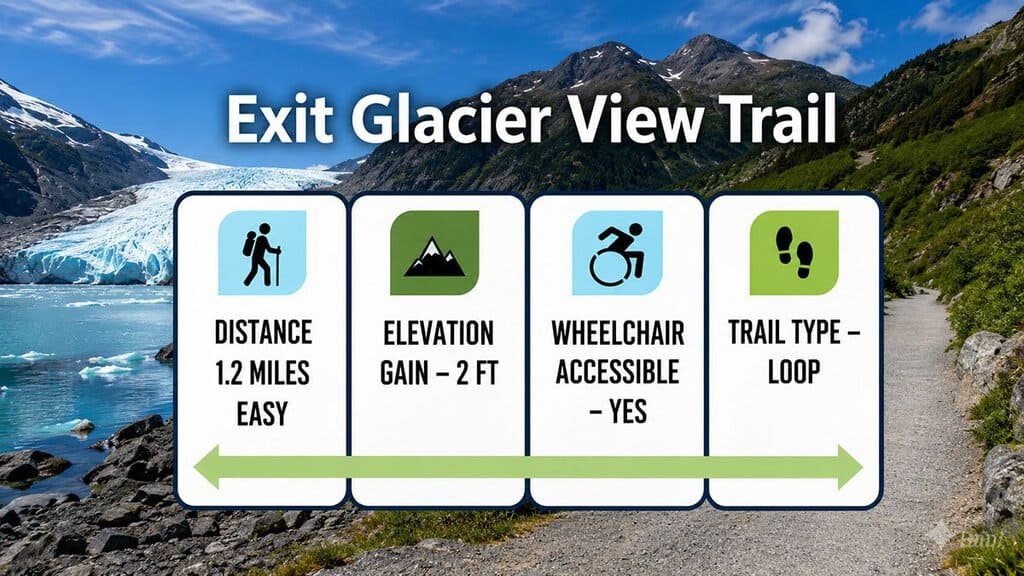
If you’re looking for an easy introduction to Exit Glacier, start with the Glacier View Trail, also called the Lower Trail. The roughly one-mile loop passes through a beautiful cottonwood forest and leads to a viewpoint overlooking the glacier and outwash plain.
The trail is wheelchair-accessible and can be walked in either direction. It only takes about 20 minutes to complete, making it a great choice if you’re short on time or traveling with the whole family.
There’s even a spotting scope at the viewpoint that lets you get a closer look at the glacier.
PRO TIP: The trail is paved for part of the route, but you’ll encounter soft gravel on the remainder. It’s still an easy walk, but keep that change in surface in mind if you’re using a wheelchair or mobility aid.

Don’t Miss the Glacier’s Retreat Markers
One of the things we found most fascinating along the trail was seeing the markers showing where Exit Glacier once reached. Signs along the route mark the glacier’s former locations, including the 1961 marker we photographed..
It’s hard to imagine the glacier reaching all the way to these spots when you’re standing there today. The markers make the glacier’s retreat much more tangible than simply reading about it.
At one point, Exit Glacier extended much farther down the valley, almost to Seward. During our 2021 visit, we couldn’t reach the toe of the glacier from the trail because it had retreated even farther than it had during our previous visit in 2012.
Seeing those markers in person really puts the changing landscape into perspective. Exit Glacier isn’t just a beautiful wall of ice; the landscape around it tells the story of a glacier that’s constantly changing.
If you have time, take a few minutes to stop at the markers rather than simply walking past them. They’re an important part of the Exit Glacier experience and give you a much better understanding of what you’re seeing.

Moderately Difficult: Glacier Overlook Trail
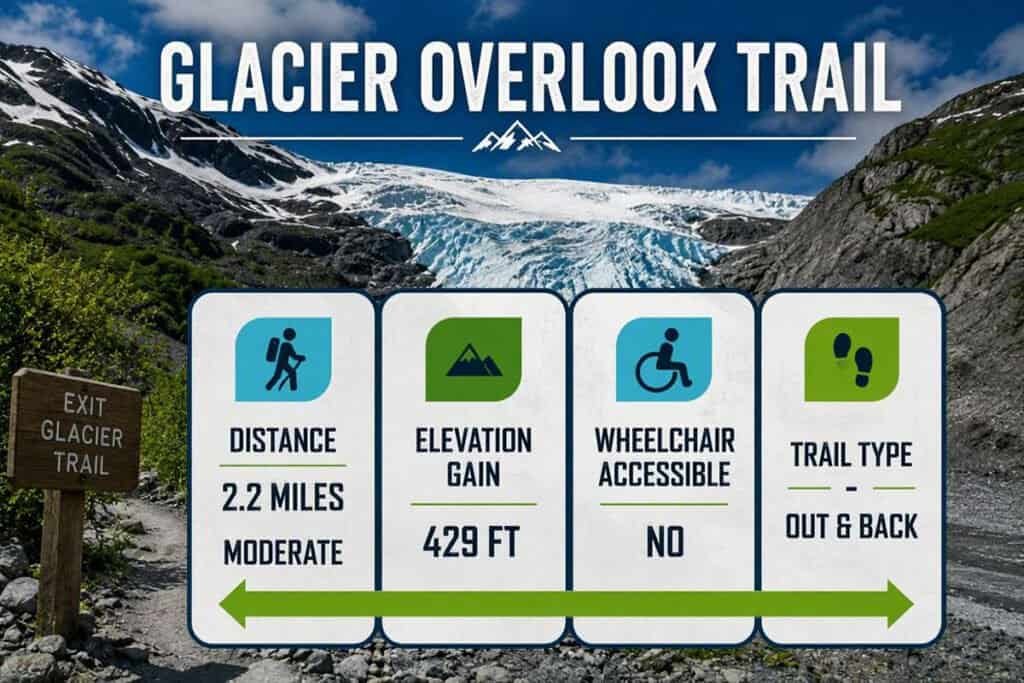
If you want to get a little closer to Exit Glacier, step it up with the Glacier Overlook Trail.
We started on the paved portion of the Glacier View Trail before turning toward the overlook. The trail took us through thick woods, with sunlight filtering through the trees. Then, almost suddenly, the forest opened up and we found ourselves walking across the rocky glacial moraine.
The change in scenery was pretty amazing.
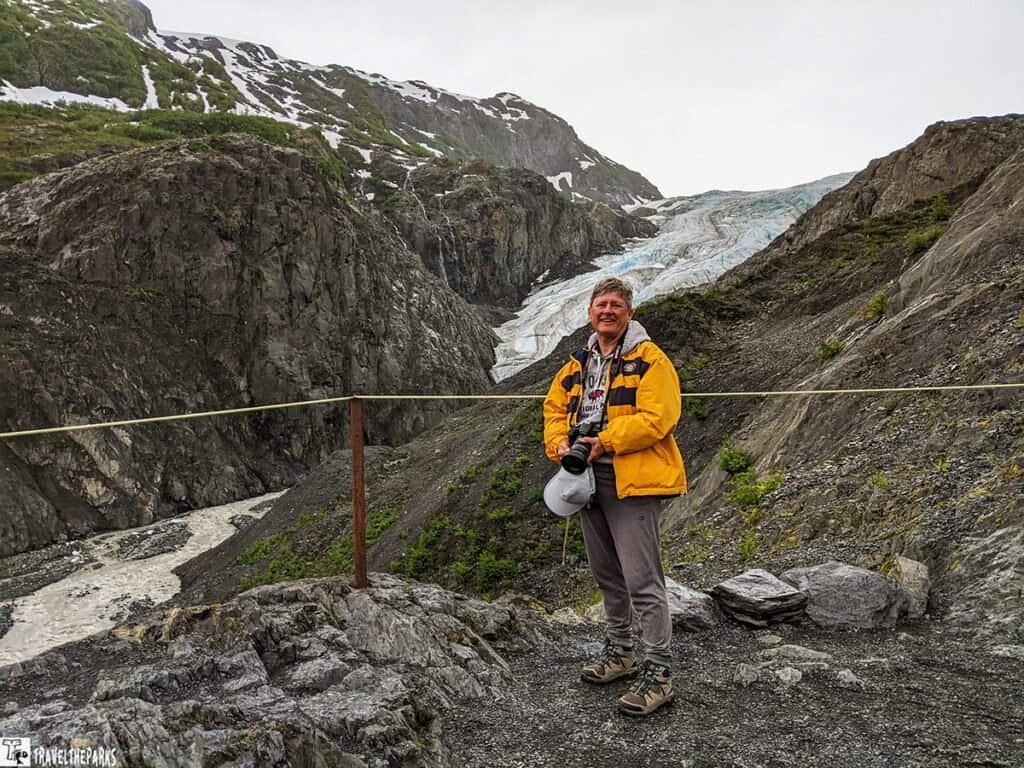
The trail climbs toward the top of the glacial valley, eventually opening up to impressive views of Exit Glacier and the surrounding mountains. It’s a much more strenuous walk than the Glacier View Trail, but the views make the extra effort worthwhile.
The route to the overlook is approximately 1.2 miles, with about 429 feet of elevation gain. Give yourself plenty of time to enjoy the scenery rather than treating it like a race.
Standing above the valley and looking toward the glacier was one of those Alaska moments we’ll always remember.
Harding Icefield Trail: An All-Day Adventure
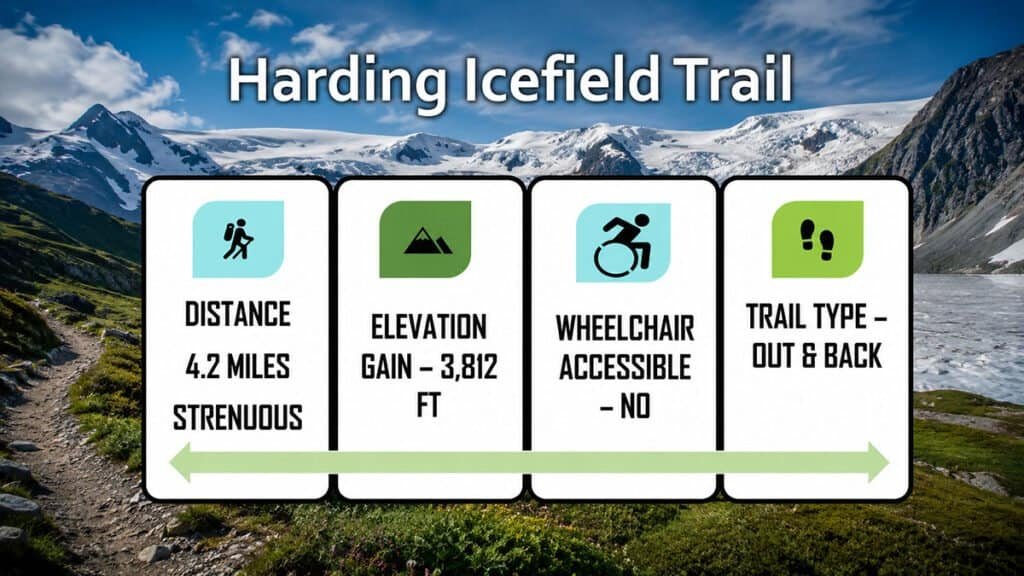
For serious hikers, the Harding Icefield Trail is the big challenge at Exit Glacier.
The trail climbs more than 3,500 feet over approximately 4.2 miles to reach the icefield. The Harding Icefield itself covers roughly 700 square miles, and reaching the top gives you sweeping views across a landscape of ice, mountains, and rock.
Plan on 6–8 hours for the round trip and come prepared. The weather can change quickly as you gain elevation, so dress in layers. Even if it’s warm down at the Nature Center, temperatures can be considerably colder near the icefield.

The trail passes through forests, heather-filled meadows, and tundra as you climb above the treeline. Wildlife is another reason to keep your eyes open. This is bear country, so make plenty of noise, stay alert, and follow current park guidance regarding wildlife encounters.
We recommend bringing binoculars if wildlife watching is on your list. You never know what you might spot along the way.

The Blue Ice of Exit Glacier
One of the things that really surprised us was the color of the ice. In bright sunlight, portions of the glacier take on an incredible crystalline blue. Light passing through the dense ice creates those deep blue tones, and we could see small caverns and crevasses throughout the glacier.
It was beautiful in the sunshine, but this is one place where you need to remember that a glacier isn’t just a pretty wall of ice. Crevasses, unstable ice, and changing conditions can make getting onto or near the ice extremely dangerous. Don’t venture onto the glacier or icefield unless you’re properly equipped and with an experienced guide.
We Didn’t Make It to the Top
I’ll admit it—we didn’t make it all the way to the top of the Harding Icefield Trail.
We set out with the goal of reaching the icefield, but about halfway up, we realized we simply didn’t have enough time or stamina to finish the hike. And that’s okay. One of the things we’ve learned from traveling through Alaska is that sometimes the smart choice is knowing when to turn around.
Even halfway up, the scenery was incredible.
If you’re hiking the Harding Icefield Trail during the shoulder seasons or early in the year, be especially cautious. Snow can cover sections of the trail, and route markers may be difficult to follow. Conditions can change quickly, so check with the Nature Center or rangers before setting out.
Our advice: Choose your trail based on the time you have, your fitness level, and current conditions. You don’t have to conquer the Harding Icefield to have an amazing day trip to Exit Glacier in Kenai Fjords National Park. Sometimes the shorter trails deliver all the glacier views you’re looking for.

Getting Your Feet Wet! Exploring the Outwash Plain
We wanted to get closer to Exit Glacier, so instead of stopping at the overlook, we continued along the paved and gravel trail toward the outwash plain. Our goal was to reach the toe of the glacier.
This part of the adventure was definitely more challenging than we expected.
Meltwater flowing from the glacier creates a maze of braided channels across the outwash plain. There isn’t a traditional marked trail because the water constantly changes the landscape. As the amount of meltwater rises and falls, new channels form while others disappear.
To make our way toward the glacier, we had to walk along—and sometimes through—the rushing water of Exit Creek. The streams eventually flow into the Resurrection River.
If you’re planning to explore the outwash plain, good footwear is a must. We recommend sturdy hiking shoes or, if conditions require getting deeper into the water, wading boots with neoprene socks.
Walking the Outwash Plain Isn’t as Easy as It Looks
The water was absolutely freezing, and the rocks were slippery under our feet. We ended up with soaked shoes, but that didn’t stop us. We were determined to get as close to the glacier as we could.
Even though the day was warm and sunny, the closer we got to the glacier, the more we noticed the cold air coming off the ice. The combination of freezing meltwater, cool glacier winds, and the rugged gravel made the experience exhilarating.

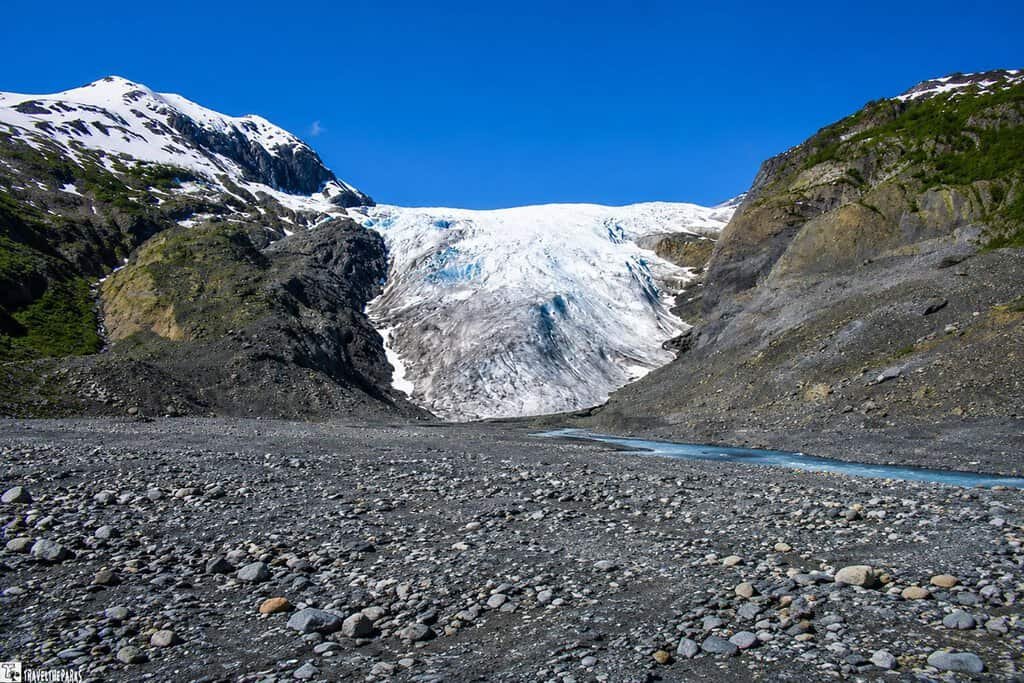
Once we reached the base, we were rewarded with an incredible view of Exit Glacier. The blue-white ice towered above us, with meltwater rushing out from underneath.
But this is where we need to add an important warning.
Stay Off the Glacier and Away From Ice Caves
When we made this trip in 2012, we were able to walk right up to the toe of Exit Glacier and even step onto the ice. It was an incredible experience and one we won’t forget.
Things had changed dramatically by our next visit in 2021.
The glacier had retreated, and the area around the toe was no longer safe to access. An ice cave had formed beneath the glacier, creating a serious collapse hazard. Never enter an ice cave or walk beneath overhanging glacier ice. Ice can collapse without warning, even when it appears stable.
his was a powerful reminder that Exit Glacier is constantly changing. The place we could safely explore in 2012 wasn’t the same place we encountered in 2021.
Our advice: Enjoy the glacier from a safe distance and follow all current National Park Service closures and warnings. The glacier is spectacular enough without putting yourself in danger to get closer.
End of the Trail: Exploring the Glacial Moraine
On our walk back from the glacier, we noticed something we hadn’t really appreciated on the way in—the cold wind coming off the ice. Every so often, a strong gust would roll down the glacier valley.
These are known as katabatic winds, created when cold, dense air moves downhill from the glacier. Think of the rush of cold air you feel when you open your freezer on a hot day. That’s essentially what we were experiencing on a much larger scale.
The rocky landscape around Exit Glacier also tells a story. The glacial moraine is made up of rocks, gravel, and other debris carried and pushed along by the moving ice. Large boulders scattered across the landscape are reminders of the incredible force of a glacier.
And then there are the retreat markers.
Seeing the 2010 marker on our 2021 visit really drove home how quickly this landscape is changing. Exit Glacier has retreated significantly over the years, and the markers give you a tangible way to see that change rather than simply reading about it.
The glacier we saw in 2021 looked dramatically different from the one we remembered from our 2012 visit. That’s one of the things that makes visiting Exit Glacier so powerful. You’re not just looking at a glacier—you can actually see evidence of its changing position throughout the landscape.

The Many Views of the Resurrection River
After our hike, we headed back to the RV, changed into dry footwear, and grabbed a snack and something warm to drink. This is one of the perks of traveling Alaska by RV! Everything we needed was right there with us.
Once we were warmed up, we headed back down Exit Glacier Road. We stopped at several pullouts along the way to take in the views across the Resurrection River.
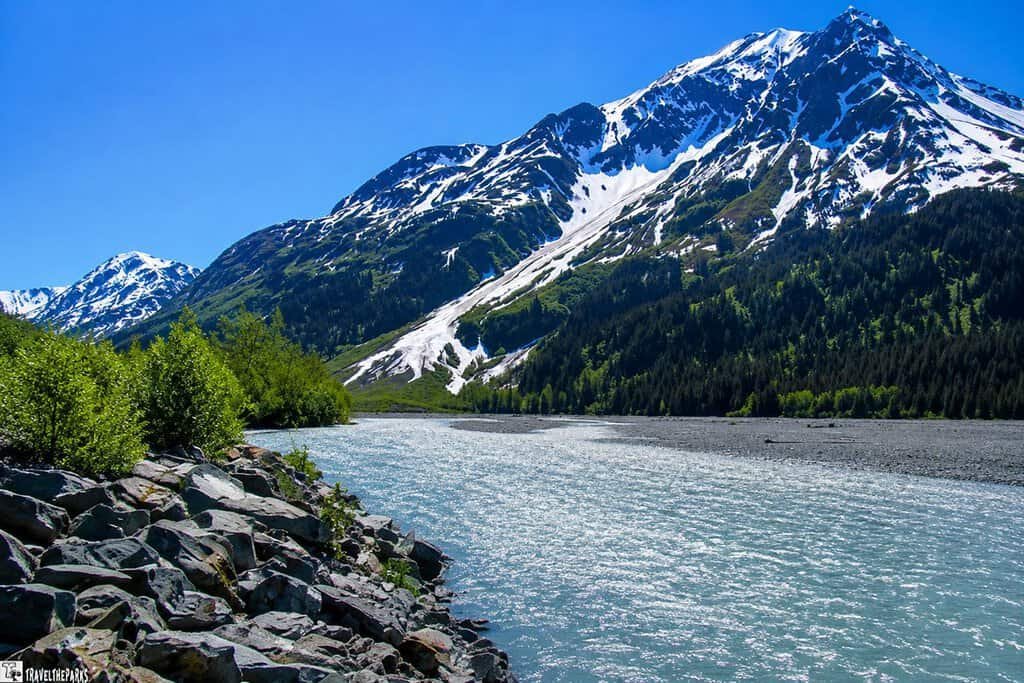
The scenery was spectacular. Across the river, mountain slopes rise toward alpine glaciers, while the river winds through the valley below. Look closely and you’ll see the classic U-shaped valleys carved by glaciers, another reminder of how much these massive rivers of ice have shaped the Alaska landscape.
We found ourselves stopping more than once just to take it all in. Sometimes the best part of an Alaska road trip is simply pulling over and enjoying the view.
Final Thoughts: You See the Best of Kenai Fjords National Park at Exit Glacier
Our visit to Exit Glacier in Kenai Fjords National Park gave us a firsthand look at the incredible power of nature. It’s one thing to read about glaciers retreating, but standing beside the markers and seeing how far the ice has moved makes the story much more real.
Exit Glacier is also one of the easiest places in Kenai Fjords National Park to experience a glacier up close. You can take a short, accessible walk to the viewpoint, tackle a more challenging trail, or simply spend some time learning about the glacier and the landscape around it.
And for us, Exit Glacier has become one of those Alaska places we keep coming back to. We’ve visited more than once, and seeing how much the glacier changed between our trips made an impression on us. Every visit gives us a little more appreciation for this incredible landscape.
If you’re visiting Seward, we think Exit Glacier belongs on your Alaska itinerary. Whether you’re planning a quick stop or spending the day hiking, it’s an experience that’s hard to forget.
Be sure to add Exit Glacier in Kenai Fjords National Park to your Alaskan road trip itinerary. And if you’re planning a larger Alaska adventure, don’t forget to check out our Alaska dream vacation for more ideas.
Have you visited Exit Glacier? We’d love to hear about it! Share your favorite Exit Glacier memory in the comments below.